
Inside the College Accelerator Experience at iCode Columbia
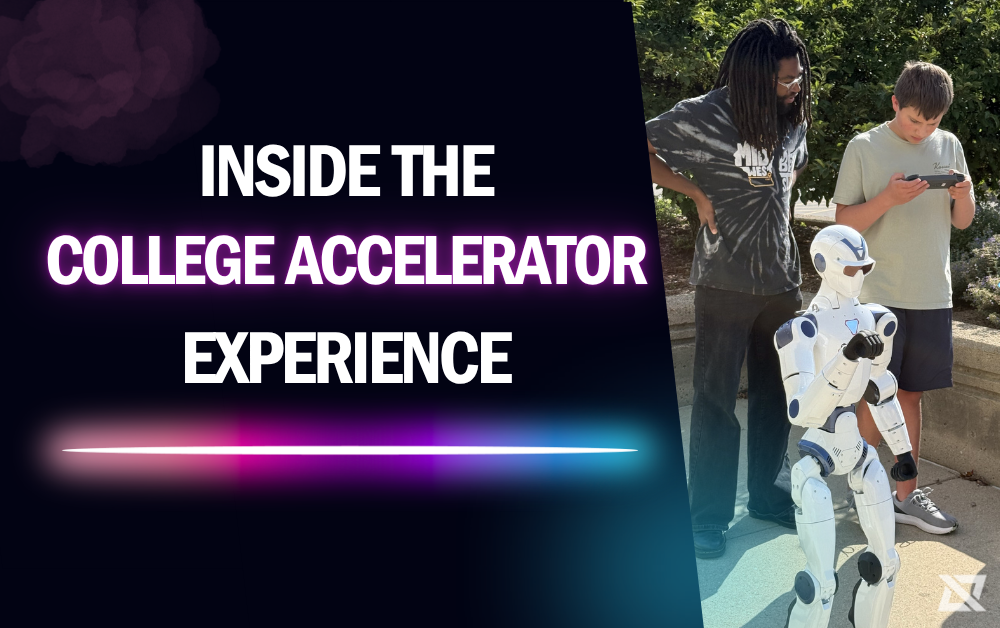
Some STEM programs stay on the surface. This one goes deeper. The College Accelerator at iCode Columbia is a STEM summer program for teens. Students work on a real humanoid robot. They code it, debug it, and build projects with it. Instructors teach every step. The program is offered with Humanoid Robotics at this campus. Columbia teens can add serious technical experience to their college story.
Why the College Accelerator Exists
The World Economic Forum’s Future of Jobs Report 2025 expects 39% of core skills to be disrupted by 2030. For teens in Columbia, that is a good reason to learn how to learn. The College Accelerator focuses on durable skills, built through real technical work instead of lectures.
A Program Built on Real Hardware, Not Simulations
At iCode Columbia, students learn on the Unitree R1 EDU. This is a real humanoid robot, not a toy. It weighs 25kg and moves with up to 40 degrees of freedom. Onboard, an NVIDIA Jetson Orin processor provides 100 TOPS of compute. 3D LiDAR and depth cameras handle spatial awareness. Students program it directly in Python and C++ with ROS 2, the same framework professionals and researchers use.
Why Real Hardware Changes the Experience
Genuine hardware brings genuine challenges. A sensor may need calibration, or a command may not do what the student expected. Those challenges build real troubleshooting skill. A fixed simulation cannot offer the same experience.
Why Mentors Remain Central to the Experience
A humanoid robot is impressive, but it is a tool. The teaching comes from the instructor. An instructor leads every session at iCode Columbia. They explain the concept, answer questions, and guide students through setbacks. The robot makes the lesson hands-on. The instructor makes it stick.
A Closer Look at the Skills Progression
Weeks One and Two: Getting Comfortable
In the opening weeks, students focus on the basics of sensing and movement. They read sensor data, give the robot simple commands, and see how Python and C++ instructions become real motion.
Middle Sessions: Solving Real Problems
The middle sessions raise the challenge. Tasks become open-ended, with more than one way to succeed. Students must decide how to approach each one instead of following a script.
Why Open-Ended Problems Matter So Much
A student weighing two approaches, trying one, and adjusting after seeing the result is doing real problem-solving. Colleges and employers both describe this as a valuable skill. Open-ended tasks give students that practice.
Later Sessions: Independent Projects
Near the end, students take the lead. They combine their skills to program a sequence of actions and bring in sensor input. They troubleshoot largely on their own, with the instructor available as support.
What Students Take Away
Technical Skills With a College-Ready Story
After the program, students can point to specific work. They have programmed a real robot. They can describe what they built and learned in essays, interviews, and activity descriptions.
Confidence With New Tools
The program also builds comfort with the unfamiliar. Students learn that a new tool is something they can figure out. Adaptability like that will stay in demand in future classrooms and workplaces.
What a Typical Session Looks Like
Guided, Not Self-Taught
Students are never left to figure it out alone. Each session is taught by an instructor who introduces the concept, answers questions, and helps when something goes wrong. The robot is the tool. The instructor is the teacher.
From Concepts to Code
A typical session moves from explanation to action. After a brief walkthrough of the concept, students write commands, run them on the robot, and watch what happens. The quick feedback helps them improve each attempt.
Building Toward Bigger Projects
Early sessions focus on fundamentals, such as basic movement, sensor readings, and simple commands. Later sessions build toward multi-step projects that combine several of those skills at once.
Why This Progression Matters
This structure means students are not handed a finished project to copy. They build the skills to create something themselves, step by step.
Who This STEM Summer Program for Teens Fits
Students Curious About Robotics and Engineering
If a student already likes robotics, coding, or engineering, the College Accelerator takes that interest further. It adds structure and guidance.
Students Still Figuring Out Their Interests
Some students join without knowing where their interests lie. The College Accelerator suits them too. Spending time with real hardware is often the fastest way to learn whether a technical path fits.
Students Preparing College Applications
Core workplace skills are expected to change fast. Students applying to college in the next few years should consider building this experience early. It can be an advantage now, ahead of the day it becomes a requirement.
Ready for the next step? Check availability for the College Accelerator and Humanoid Robotics program on the iCode Columbia homepage. The College Accelerator Program page explains in detail what students build and learn.
Frequently Asked Questions
Do students need coding experience before joining the College Accelerator?
No prior experience is required. Sessions start with the fundamentals and build up from there, and instructors guide students the whole way.
What robot do students actually work with?
The robot is the Unitree R1 EDU. It weighs 25kg and offers up to 40 degrees of freedom. It carries an NVIDIA Jetson Orin processor (100 TOPS) with 3D LiDAR and depth cameras.
What programming languages are used in the program?
Students program the robot in Python and C++ through ROS 2. Professionals and researchers use the same robotics framework.
Is the instructor still involved, or do students mostly work with the robot alone?
Instructors lead every session, teaching concepts and guiding students as they work. The robot helps students learn, but the instructor does the teaching.
Is the College Accelerator available at iCode Columbia?
The College Accelerator is offered at iCode Columbia with the Humanoid Robotics program. It is offered at select iCode campuses, so check the Columbia homepage to confirm current availability.