
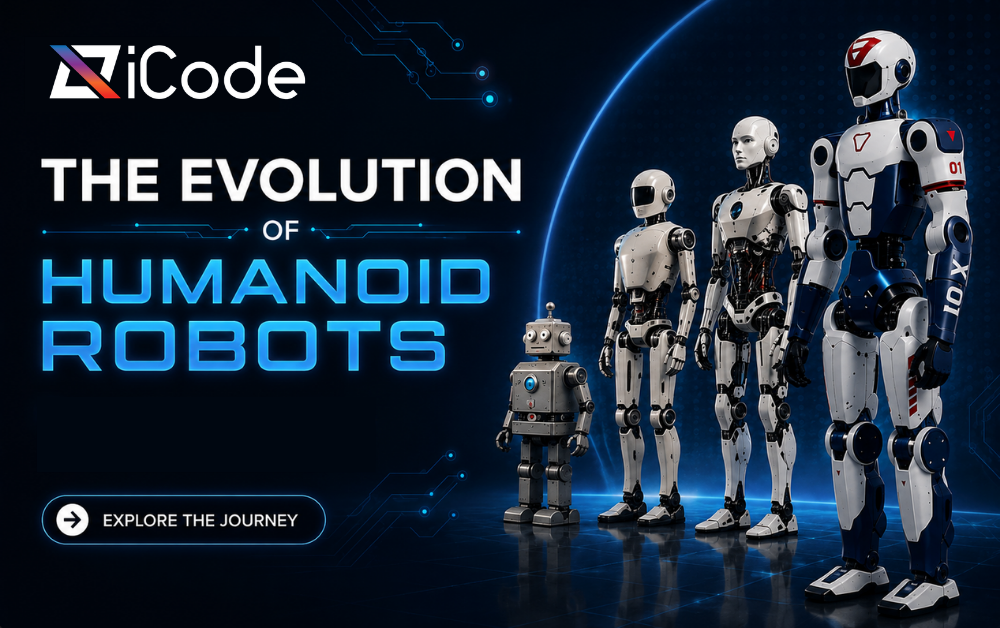
The Evolution of Humanoid Robots: From Science Fiction to STEM Education
A Region Already Focused on Cyber and Systems
Augusta has become a serious hub for cybersecurity and systems work over the past decade, largely thanks to the military and defense presence nearby. Families here are often more familiar than most with careers built around code, sensors, and secure systems — which makes a hands-on robotics program less of a leap and more of a natural next step.
Working With the Unitree R1 EDU
At iCode Augusta, students program the Unitree R1 EDU, a 25-kilogram humanoid robot with up to 40 degrees of freedom, an onboard NVIDIA Jetson Orin AI computer running at 100 trillion operations per second, and 3D LiDAR paired with depth cameras for sensing. Students write the controlling code themselves in Python and C++ through ROS 2.
Navigating Around a Problem
A typical project has students coding the robot to detect an obstacle using its onboard sensors and reroute around it in real time, without a mentor pre-programming the path. The first version usually reacts a beat too late or takes too wide a turn. Debugging that timing — reading the sensor data, adjusting the response — mirrors the kind of real-time problem-solving used in systems and security work every day.
What students learn quickly is that a slightly-too-slow response and a slightly-too-fast one look almost identical from the outside — the robot bumps the obstacle or steers awkwardly around it either way. Figuring out which one is actually happening, and by how much, requires reading the code and the sensor output carefully rather than guessing from what the robot looks like it’s doing. That precision is exactly the habit systems and security work depends on.
A Mentor, Not the Machine, Does the Teaching
The robot doesn’t run the lesson. An instructor does, covering the code, the mechanical gears and linkages that turn that code into physical movement, and the electronics that tie sensors to the onboard computer.
Inside the Youth Innovation Program
This runs under the Youth Innovation Program, also called the College Accelerator Program for the outcome it’s built around. It’s an 8-week, mentor-led cohort capped at 12 students in three teams of four to five. Robotics is one project path, alongside web and mobile app development, data analysis, AI and automation, and digital media, but it’s the one offering access to hardware students otherwise wouldn’t touch this early.
Presenting the Work, Not Just the Robot
Every cohort finishes with a live pitch to iCode Corporate leadership, where students explain their project, including what went wrong before it worked.
A Natural Fit for This Region
Augusta’s growing cyber and defense presence has made real-time troubleshooting a familiar concept for a lot of local families, even outside of work conversations. This program gives students a direct, hands-on version of that same discipline years before they’d encounter it professionally — reading sensor data, spotting a delay or an error, and correcting it under a bit of real pressure. It’s a small-scale rehearsal for the kind of work this region is already known for.
Students don’t need prior robotics or coding experience to apply. The eight weeks are built to take a student from basic instruction to a finished, working project, with mentors adjusting the pace to match where each student starts. What matters more than a head start is a willingness to keep testing something until it works.
That eight weeks breaks into three stages: fundamentals first, then several weeks of building and testing where most of the actual troubleshooting happens, and a final stretch for refining the project and preparing the presentation for iCode Corporate leadership.
Twelve Seats Available
Cohorts are capped at 12 students for real mentor attention. If your student already thinks in terms of systems and problem-solving, apply to the Youth Innovation Program (College Accelerator Program) at iCode Augusta.