
What’s Next After the College Accelerator Program?
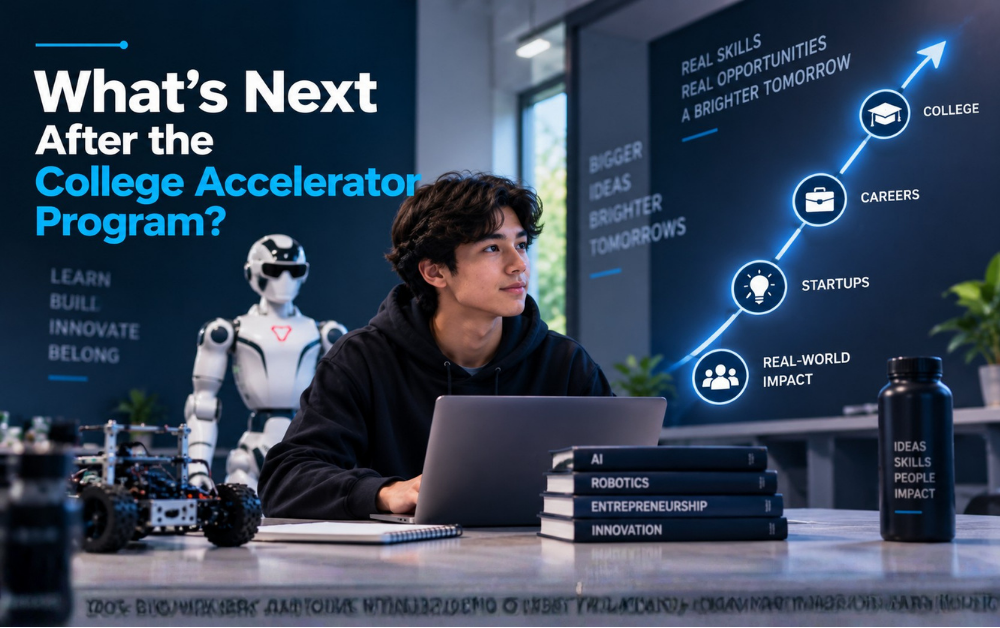
A student who’s spent months building, coding, and presenting real robotics projects doesn’t just stop learning the day the program wraps up. The skills stick around — and so does the momentum, if there’s somewhere for it to go.
At iCode Boise, ID, “what’s next” is a real, planned answer, not an afterthought. Here’s how students keep building on what the College Accelerator Program started.
What “Finishing” the Program Actually Means
Completing the College Accelerator Program means a student has worked through real, hands-on robotics and coding projects, built confidence presenting their own work, and picked up habits — planning, testing, problem-solving — that carry over well beyond any single project.
It’s worth being clear about what “finishing” doesn’t mean. It isn’t the end of learning robotics, and it isn’t a certificate that just goes in a drawer. It’s a marker that a student has the foundation to take on harder, more open-ended work — which is exactly why the question of what comes next matters so much.
What a Student Walks Away With
- A working knowledge of programming a real humanoid robot platform, not just simulations
- A track record of finished projects they can explain and defend
- Practice handling setbacks, feedback, and presenting to an audience
Building a Portfolio for College and Beyond
A finished robotics project is more than something to be proud of — it’s real material a student can point to later, in a college application or an interview, when “I’m interested in STEM” needs actual evidence behind it.
What Colleges Actually Look For
Admissions readers see plenty of generic extracurricular lists. A specific project — what the student built, what problem it solved, what they’d do differently — stands out precisely because it’s specific.
It’s the difference between “I’m interested in robotics” and a two-minute story about the time a sensor kept misreading distance and the fix that finally worked. One of those is a claim. The other is evidence.
Turning Projects Into a Portfolio
Students are encouraged to document their work as they go — photos, short write-ups, even video of a working demo — so that by the time an application deadline arrives, the material already exists instead of needing to be reconstructed from memory.
The Paths Students Take Next
There isn’t one single “next step” after the program — there are several, and which one fits depends on what a student actually wants more of.
Advanced Robotics Projects and Capstones
Students who want to keep building move into more open-ended, advanced project work — the kind where they’re setting their own goals for the robot rather than following a structured curriculum step by step.
The difference is real: instead of a mentor defining the task, the student defines it, and has to figure out on their own what “done” actually looks like. That shift from following instructions to setting a goal is a big part of what makes this next stage feel different.
Becoming a Mentor-in-Training
Some of the strongest next steps aren’t about building more — they’re about teaching. Former students who move into peer mentoring roles end up reinforcing their own understanding while helping someone else get their first project working.
It’s a role that tends to surprise students. Explaining a concept they thought they already understood, to someone hearing it for the first time, often reveals gaps they didn’t know they had — and closes those gaps faster than any amount of solo practice would.
Competitions, Showcases, and Bigger Stages
For students who want to keep testing themselves, robotics competitions and public showcases offer a bigger stage than a classroom demo — a chance to see how their work holds up against other teams and other ideas, and to pick up new ideas from teams approaching the same kinds of problems differently.
That’s not the right next step for every student, and it doesn’t need to be. It’s one option among several, offered to the students who are genuinely drawn to that kind of challenge.
What tends to surprise families is how much a student’s confidence carries over from the program itself. A student who’s already used to presenting a finished project and fielding real questions walks into a competition setting with a head start most first-time competitors don’t have.
Why the Unitree R1 EDU Platform Supports Long-Term Growth
Whatever direction a student takes next, it helps that they’re not starting over on new hardware. The Unitree R1 EDU platform used throughout the program has enough range that advanced work is a continuation, not a restart.
Quick Spec Snapshot
| Spec | Unitree R1 EDU |
| Weight | 25 kg |
| Degrees of Freedom | Up to 40 |
| Onboard Compute | NVIDIA Jetson Orin, 100 TOPS |
| Sensing | 3D LiDAR + depth cameras |
| Programming | Python / C++ via ROS 2 |
The Mentor’s Role in Planning What’s Next
Mentors at iCode Boise, ID talk with students and families before the program ends, not after — asking what a student actually enjoyed most, and pointing toward the next step that fits rather than a default one-size-fits-all path.
That conversation usually starts with a simple question: which part of the program did you look forward to most? The answer — building, testing, explaining, helping a teammate — tends to point pretty directly toward the right next step, whether that’s advanced projects, a competition, or a mentoring role.
Why This Matters for Long-Term Career Readiness
The World Economic Forum’s Future of Jobs Report 2025 estimates that 39% of core workplace skills will be disrupted by 2030 — which makes an early habit of continuous, self-directed learning one of the more valuable things a program like this can leave a student with.
A student who’s used to picking their own next challenge, rather than waiting for one to be assigned, is already practicing the kind of adaptability that outlasts any specific skill or tool.
That habit is worth more over a career than any single technology a student learns today, since the tools themselves are all but guaranteed to change well before that student reaches the workforce.
Frequently Asked Questions
Can completing the program help with college applications?
Yes. Finished projects, presentations, and any competition or showcase involvement give students concrete, specific material to draw on for college essays and applications, rather than generic extracurricular descriptions.
Is there a way for former students to stay involved with iCode?
Many students move into peer mentoring or leadership roles, helping newer students the way they were once helped, which keeps them connected to the program while building a different kind of skill.
Do students compete anywhere after finishing the program?
Some students go on to robotics competitions and showcases, using what they built during the program as a starting point rather than starting from scratch.
How does a mentor help plan what’s next for a student?
Mentors talk with students and families near the end of the program about specific interests and strengths, then point toward the next step — competition, advanced projects, mentoring — that actually fits that student.
Ask a student what they’re doing next after the College Accelerator Program, and the best answer is that they already know — because the path forward was part of the plan from the start.
That’s the approach at iCode Boise, ID, one stage building into the next.
Explore how it all fits together inside the College Accelerator Program.