

Why Today’s Students in Boise, ID Should Learn About Humanoid Robots Before College
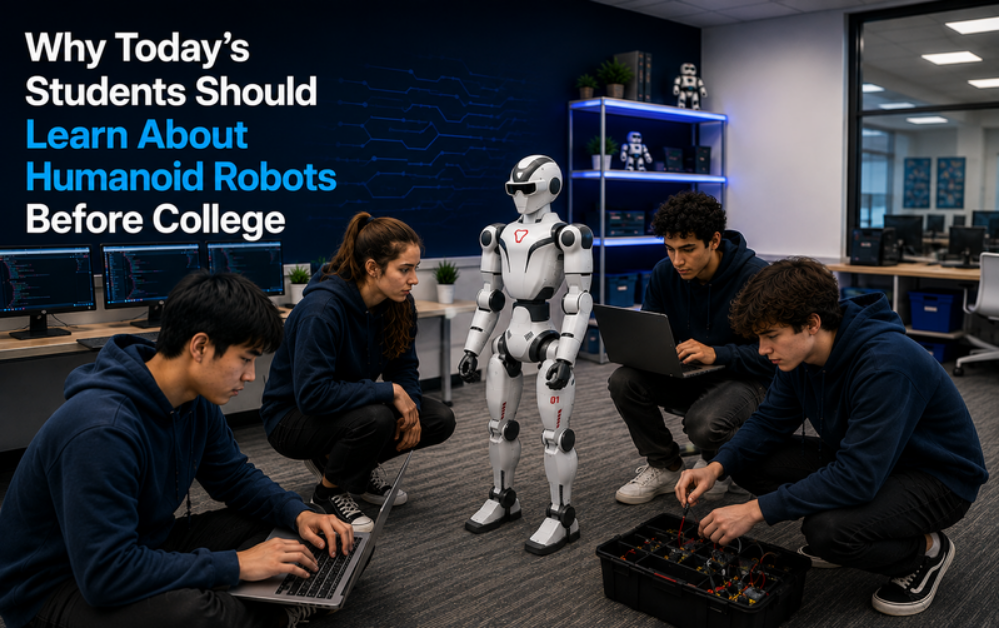
Ten years ago, a walking, talking humanoid robot was something you saw in a movie, not something a middle schooler could program. That’s no longer true. In Boise, ID — a fast-growing tech hub anchored by major semiconductor and manufacturing employers — students now have a chance to work directly with humanoid robotics before they ever fill out a college application.
What Counts as a Humanoid Robot Today
A humanoid robot is simply a robot built to move and interact the way a person does — walking on two legs, using arms and hands, reading its surroundings through cameras and sensors. What used to be a research-lab curiosity has become something students can actually work with, not just watch from a distance.
Inside iCode’s Youth Innovation Program, students work directly with the Unitree R1 EDU — a robot weighing about 25kg, capable of up to 40 degrees of freedom, and running an onboard NVIDIA Jetson Orin AI module rated at roughly 100 TOPS. It reads its environment through 3D LiDAR and depth cameras, and students program it in Python and C++ through the ROS 2 framework — the same robotics software framework used in professional labs.
Why This Skill Set Matters Before College Applications
Most students don’t touch anything like this until their second or third year of an engineering degree, if they touch it at all. Getting hands-on exposure to it while still in middle or high school means a student walks into college application season with something most of their peers don’t have: a real project, not just a class they sat through.
Admissions officers read thousands of essays about “interest in STEM.” A student who can point to a robotics team they were part of, a problem they debugged, or a project they presented stands out for a reason that has nothing to do with luck.
The Skills That Actually Transfer
Beyond Just Learning to Code
Real coding experience: Students write and test actual Python and C++ code that controls a physical machine, not just code that runs in a browser window.
Problem-solving under pressure: When a robot doesn’t behave the way it’s supposed to, there’s no shortcut — students have to figure out why and fix it, which builds the kind of patience and troubleshooting instinct that transfers directly to engineering coursework.
Presenting technical work: At the end of the program, student teams pitch what they built to iCode’s corporate team — a rare chance to practice explaining technical work clearly to people who weren’t in the room while it was being built.
Why This Looks Different From a Typical Coding Class
The difference is the platform. Writing code that moves a real, physical robot forces a level of precision that a purely on-screen project doesn’t demand — mistakes show up immediately, and so does the fix.
How iCode’s Boise Campus Builds This Skill Set
iCode’s Youth Innovation Program — also known as the College Accelerator Program — runs as an 8-week, mentor-led cohort. Twelve students split into three teams, work directly with the Unitree R1 EDU platform, and spend the final session presenting their project to iCode’s corporate team. The mentors run the sessions and set the technical direction; the robot is the tool students learn to build with, not the instructor.
Frequently Asked Questions
Does my child need coding experience before joining? No. The program is built to bring students up to speed step by step, starting with the basics of Python and C++ before moving into robot-specific programming.
Is this only for students planning to major in engineering? No. Students exploring any STEM-related path — or simply curious about robotics — get value from the program. The skills involved (problem-solving, teamwork, presenting) apply well beyond one specific major.
How much of the work is hands-on with the robot itself? A significant portion. Students write code, test it directly on the Unitree R1 EDU, and troubleshoot in real time rather than working only from a screen.
What happens at the end of the 8 weeks? Each student team presents their project to iCode’s corporate team — a real audience, not just a classroom presentation.
What age group is this designed for? The program is built for middle and high school students who are ready for a more advanced, project-based robotics experience.
Get Started Before College Decisions Roll Around
Robotics experience is far more useful to a student while there’s still time to build on it. Learn more about iCode Boise’s Youth Innovation Program and see current enrollment windows, or explore everything happening at the Boise campus to find the right starting point.
Students in Boise don’t have to wait for college to find out whether robotics is something they actually enjoy or a subject they were only good at on paper. The earlier that question gets answered, the more useful the answer is.