
Inside the College Accelerator Experience at iCode Canton
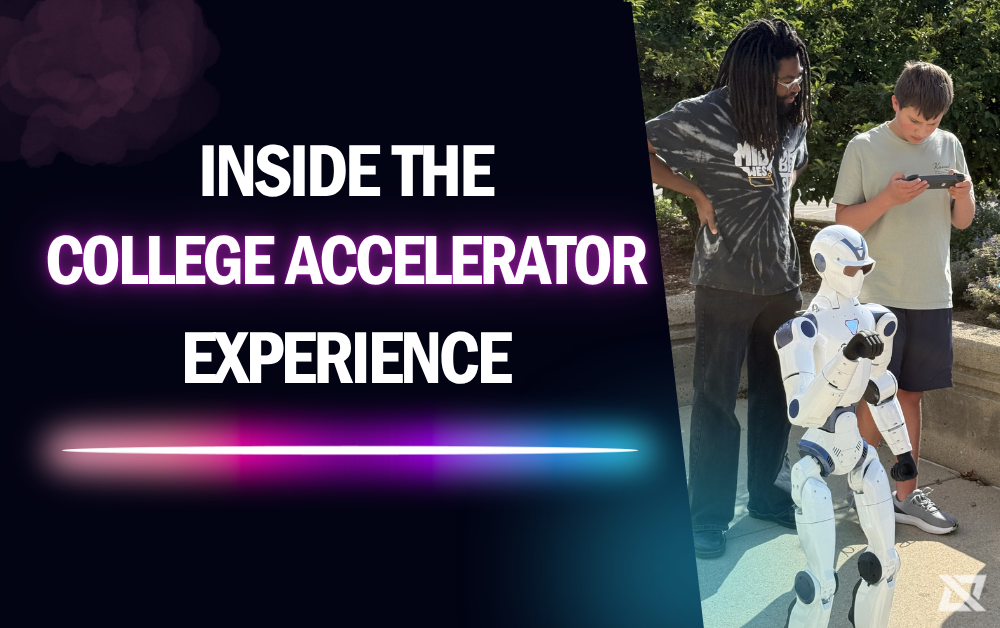
Ask ten families what a STEM program is, and you will hear ten different answers. The College Accelerator at iCode Canton has a clear one. It is a STEM summer program for teens built around hands-on technical work with a working humanoid robot. Students program it, troubleshoot it, and build with it. Instructors lead each session, and the program is offered with Humanoid Robotics. Canton teens can build real technical experience without leaving their own community.
Why the College Accelerator Exists
The World Economic Forum’s Future of Jobs Report 2025 estimates 39% of core workplace skills will be disrupted by 2030. That makes technical fluency and adaptability more valuable than any single fact a student memorizes. The College Accelerator was designed with this in mind. It builds lasting skills through hands-on technical work, not passive instruction.
A Program Built on Real Hardware, Not Simulations
The robot at the center of the program is the Unitree R1 EDU, a genuine piece of robotics hardware. It weighs 25kg and offers up to 40 degrees of freedom. An NVIDIA Jetson Orin processor delivers 100 TOPS of onboard compute. 3D LiDAR and depth cameras let it sense the space around it. Students at iCode Canton code for it in Python and C++ using ROS 2. Professionals and researchers use that framework too.
Why Real Hardware Changes the Experience
Simulations tend to behave. Real robots do not always. A sensor may need calibrating, or a command may move the robot in a surprising way. Solving those problems teaches students more than any scripted exercise could.
A Closer Look at the Skills Progression
Weeks One and Two: Getting Comfortable
Early sessions cover how the robot senses and moves. Students read sensor data, issue basic movement commands, and learn how Python and C++ instructions turn into physical action.
Middle Sessions: Solving Real Problems
Midway through, the work changes. Students get small problems with no single right answer. They choose their own approach, test it, and refine it.
Why Open-Ended Problems Matter So Much
Open-ended problems are where much of the real learning happens. A student might choose between two approaches, test one, and adjust based on the result. That is the thinking colleges and employers call problem-solving.
Later Sessions: Independent Projects
In the later sessions, students combine several skills into a more complete, independent project. They program a sequence of actions, add sensor input, and troubleshoot largely on their own. The instructor is available for support, not step-by-step direction.
What a Typical Session Looks Like
Guided, Not Self-Taught
An instructor leads every session. They teach the concept first, then support students as they apply it to the robot. The robot is the tool students learn with. The teacher does the teaching by walking through concepts, answering questions, and helping students work through mistakes.
From Concepts to Code
A typical session moves from explanation to action. After a brief walkthrough of the concept, students write commands, run them on the robot, and watch what happens. The quick feedback helps them improve each attempt.
Building Toward Bigger Projects
Early sessions focus on fundamentals, such as basic movement, sensor readings, and simple commands. Later sessions build toward multi-step projects that combine several of those skills at once.
Why This Progression Matters
A step-by-step progression means students are never just following along. Each stage gives them the skills to build something of their own.
Why Mentors Remain Central to the Experience
It is worth being clear about one thing. The robot is a tool, not a replacement for a teacher. An instructor leads every session at iCode Canton. They introduce the concept, answer questions, and help when something does not go as planned. The technology makes learning tangible. The instructor makes it stick.
What Students Take Away
Technical Skills With a College-Ready Story
By the end of the program, students have hands-on experience with genuine robotics programming. They can speak about it specifically in essays, interviews, and activity descriptions. That goes well beyond a general interest in STEM.
Confidence With New Tools
Perhaps more important, students leave more comfortable with unfamiliar technology in general. That adaptability is exactly what future classrooms and workplaces will keep asking for.
Who the College Accelerator Is Built For
Students Curious About Robotics and Engineering
If a student already likes robotics, coding, or engineering, the College Accelerator takes that interest further. It adds structure and guidance.
Students Still Figuring Out Their Interests
Students who are still exploring can benefit just as much. Hands-on work with real hardware is often the clearest way to learn whether a technical field is for them. It is a better test than reading about it.
Students Preparing College Applications
Workplace skills are changing quickly. Students heading to college in the next few years have a clear reason to start now. This kind of technical experience is an advantage today and may be expected later.
Ready for the next step? Check availability for the College Accelerator and Humanoid Robotics program on the iCode Canton homepage. The College Accelerator Program page explains in detail what students build and learn.
Frequently Asked Questions
Do students need coding experience before joining the College Accelerator?
Prior coding experience is not required. The program starts with the fundamentals and grows from there, with instructors alongside the students throughout.
What robot do students actually work with?
The Unitree R1 EDU. It is a 25kg humanoid robot with up to 40 degrees of freedom. It has an NVIDIA Jetson Orin processor (100 TOPS) and 3D LiDAR and depth cameras for spatial awareness.
What programming languages are used in the program?
The program uses Python and C++ with ROS 2. This is the same robotics framework found in professional and research settings.
Is the instructor still involved, or do students mostly work with the robot alone?
The instructor is involved throughout. Every session is led by an instructor who teaches the concepts and supports students while they work. The robot is a learning tool, not a replacement for a teacher.
Is the College Accelerator available at iCode Canton?
Yes. The College Accelerator and Humanoid Robotics program are offered at iCode Canton. Not every iCode campus has them, so check the campus homepage for current availability.