

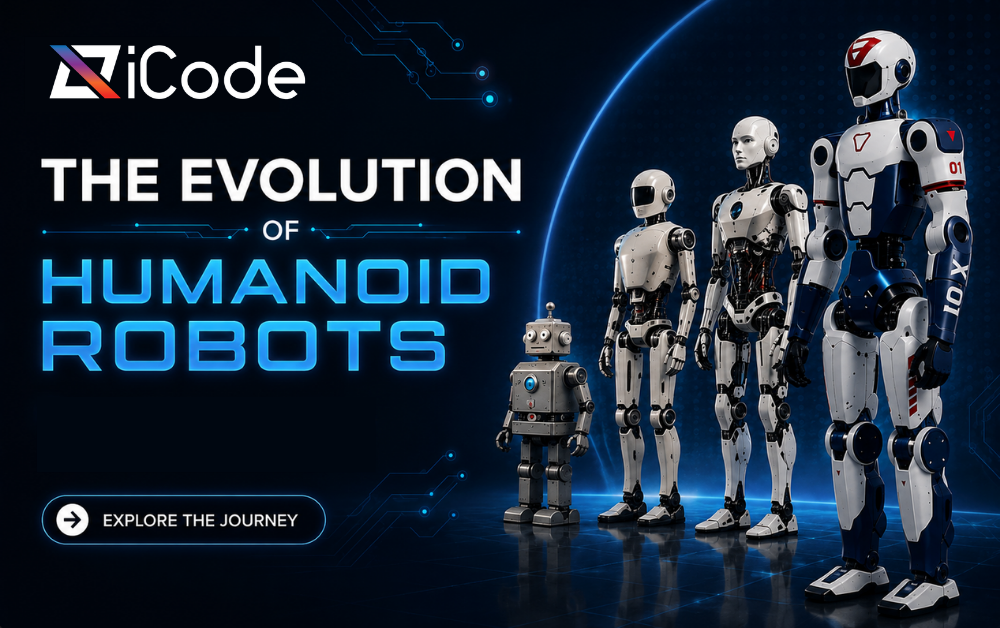
The Evolution of Humanoid Robots: From Science Fiction to STEM Education
A Town Built on Building Things
Canton sits in the middle of Michigan’s auto corridor, a region that has spent a century turning raw materials into working machines on an assembly line. That history is part of why a humanoid robotics program fits naturally here — the instinct to take something apart, understand how it moves, and put it back together better isn’t new to this area. It’s just aimed at a different kind of machine now.
At iCode Canton, that machine is the Unitree R1 EDU, a 25-kilogram humanoid robot with up to 40 degrees of freedom, an onboard NVIDIA Jetson Orin AI computer running at 100 trillion operations per second, and 3D LiDAR paired with depth cameras for real-time sensing. Students write the code that controls it directly, in Python and C++ through ROS 2 — the same framework used in professional robotics labs, not a simplified toy version of one.
Who’s Actually Teaching
The robot doesn’t run the class. A mentor does. Every session, an instructor walks students through what the code is supposed to do, how the physical gears and linkages carry out that instruction, and how the electronics tie the whole system together. Think of the robot as the engine a Canton student is learning to work on — the mentor is the one teaching them what’s under the hood.
The Youth Innovation Program
iCode calls this the Youth Innovation Program, also listed as the College Accelerator Program since that’s the outcome it’s built to produce. It runs as an 8-week, mentor-led cohort capped at 12 students, split into three teams of four to five. Robotics is one of several project paths — students can also choose web and mobile app development, data analysis, AI and automation, or digital media — but robotics is the option that hands a student equipment most people never touch until well into a career.
A Precision Problem, Not a Simple One
Say a student is trying to get the robot’s arm to pick up a small object and set it down in an exact spot, the kind of precision task an assembly line has run on for decades, just now written in code instead of built into a machine. The first attempt usually misses — the grip closes too early, or the arm stops a few centimeters short. A mentor doesn’t hand over the fix. The student traces back through their own code, isolates which line caused the miss, and adjusts it. That process, repeated across eight weeks, is where the actual skill gets built: not just knowing what code to write, but knowing how to find out why it didn’t work.
What Canton Students Walk Away With
By the end of the cohort, a student has real programming experience, a working sense of how gears and linkages turn instructions into motion, hands-on exposure to the electronics connecting sensors to computing, and a finished project with a case study and a live presentation behind it. Every cohort ends with a pitch to iCode Corporate leadership, where teams explain not just what they built, but the decisions and dead ends along the way.
Why This Matters Past the Cohort
None of this depends on a student wanting a robotics career specifically. Manufacturing in this region has always rewarded people who can diagnose a problem methodically instead of guessing at a fix, and that habit is exactly what eight weeks of debugging a robot’s code builds. A college admissions officer reading an application from a Canton student won’t just see a robotics project — they’ll see a documented example of someone who took something apart, figured out why it wasn’t working, and made it work. That’s a harder story to tell with a transcript alone, and it’s the kind of specific, provable initiative that separates one application from a thousand similar ones.
Twelve Seats, Every Session
Enrollment is capped at 12 students per cohort so mentors can actually work one-on-one, not manage a crowd. If your student already has the instinct to take things apart and figure out how they work, apply to the Youth Innovation Program (College Accelerator Program) at iCode Canton.