
10 Skills Students Develop During the College Accelerator Program in Chatham, NJ
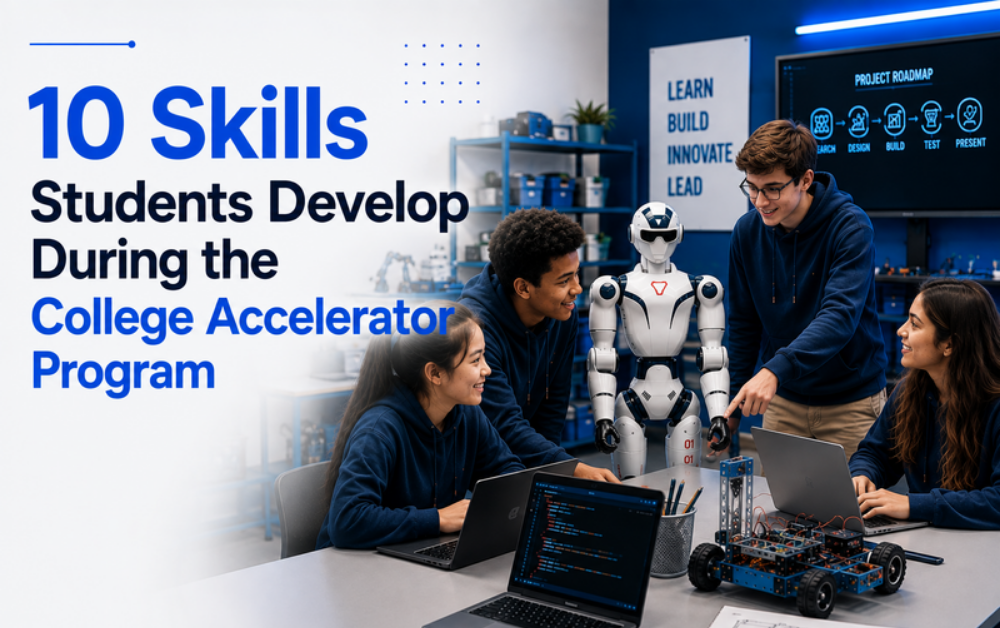
Parents in Chatham, NJ often ask the same question: what does my child actually walk away with after a semester in the College Accelerator Program? The honest answer is a lot more than a robotics badge. The World Economic Forum’s Future of Jobs Report identifies analytical thinking, creative thinking, and technological literacy as the fastest-growing skill categories employers are looking for through 2030 — and those are precisely the muscles this program is designed to build, session after session.
What Is the College Accelerator Program?
The College Accelerator Program is iCode’s advanced track for students ready to move beyond the Belt Program into college-level robotics and software engineering work. At its center is the Unitree R1 EDU humanoid robot — a 25kg platform with up to 40 degrees of freedom, an NVIDIA Jetson Orin processor delivering 100 TOPS, and 3D LiDAR paired with depth cameras for real-time perception. Students program it in Python and C++ through ROS 2, giving them direct experience with the same tools used in professional robotics development.
10 Skills Students Build Along the Way
1. Project Management and Iterative Development
Every robotics build follows a cycle: plan, build, test, fail, adjust, and try again. Students learn to break a large goal into manageable milestones, track what’s working and what isn’t, and treat setbacks as information rather than failure. That iterative mindset — plan, test, revise — is the backbone of how modern software and engineering teams actually operate, and it’s a habit that’s far more valuable long-term than any single technical skill.
2. Critical Thinking and Systematic Troubleshooting
When a robot doesn’t move the way it’s supposed to, students at iCode Chatham learn to isolate the problem methodically — is it the code, the sensor, the hardware, or the logic — rather than guessing at random fixes. That structured troubleshooting approach, tracing a problem back to its root cause, is one of the most transferable skills in the program, useful well beyond robotics in any field that involves diagnosing complex problems.
3. Creativity, Design, and Innovation
Within the structure of the curriculum, students still have real room to experiment — designing their own routines, testing alternative approaches to a challenge, and building projects that reflect their own interests. That balance of structure and creative freedom keeps engagement high and teaches students that technical work and creative thinking aren’t opposites; the best engineering solutions usually require both.
4. Adaptability and a Growth Mindset
Advanced robotics work comes with a lot of small failures before a project finally works — a sensor misreads data, a script has a typo, a movement doesn’t calibrate correctly. Mentors at iCode Chatham treat these moments as the actual curriculum, not a detour from it, coaching students to adjust their approach rather than get discouraged. Over time, students build genuine comfort with iteration and setbacks, which carries directly into how they handle challenges in school and beyond.
5. AI, Automation, and Real-World Technology Literacy
Because the Unitree R1 EDU relies on onboard AI processing for perception and decision-making, students get a concrete, hands-on introduction to how artificial intelligence and automation actually function — not as an abstract news topic, but as something they configure, test, and troubleshoot themselves. That grounded understanding of AI and automation is increasingly valuable across nearly every academic and career path, technical or not.
6. Advanced Programming in Python and C++
Students in the College Accelerator Program write real code, not simplified block sequences. The Unitree R1 EDU is programmed in Python and C++ through ROS 2, so students at iCode Chatham get direct experience with two of the most widely used languages in professional software and robotics development. They learn to structure programs, debug logic errors, and see their code translate immediately into physical movement — a feedback loop that block-based tools simply can’t offer.
7. Robotics Systems and Sensor Integration
Working with a 25kg humanoid platform that has up to 40 degrees of freedom means students learn far more than “how to code a robot.” They study how an NVIDIA Jetson Orin processor running at 100 TOPS handles real-time decisions, and how 3D LiDAR combined with depth cameras lets the robot perceive and respond to its environment. That combination of mechanical, electrical, and software understanding is exactly what separates robotics literacy from robotics fluency.
8. Computational and Algorithmic Thinking
Before a single line of code runs on the robot, students at iCode Chatham learn to break a task into logical steps — sequencing, conditionals, loops, and error-handling — and to reason about why an approach will or won’t work before testing it. That habit of thinking through a problem systematically, rather than guessing and checking, is the same skill that shows up later in advanced math, computer science coursework, and technical careers of nearly any kind.
9. Collaborative Engineering and Teamwork
Humanoid robotics projects are rarely solo work. Students pair up to divide tasks, review each other’s code, and troubleshoot hardware issues together, learning to communicate technical ideas clearly and to give and receive feedback without taking it personally. Those collaboration habits mirror how real engineering teams operate, and they’re skills that transfer directly into group projects, lab work, and eventually the workplace.
10. Public Speaking and Technical Presentation
Students in the College Accelerator Program at iCode Chatham regularly demo their projects — explaining what they built, how it works, and what they’d change next time. Learning to present technical work clearly to a non-technical audience is a skill that engineers, researchers, and entrepreneurs rely on constantly, and it’s one that’s much easier to build early, in a low-stakes setting, than to learn for the first time in a college seminar or job interview.
Frequently Asked Questions
What robot do students actually work with?
Students program the Unitree R1 EDU, a 25kg humanoid robot with up to 40 degrees of freedom, an NVIDIA Jetson Orin processor (100 TOPS), and 3D LiDAR paired with depth cameras.
What programming languages will my student learn?
Students write code in Python and C++ using the ROS 2 framework, the same tools used in professional robotics and software engineering.
How is this different from the Belt Program?
The Belt Program builds foundational STEM and coding skills across a range of topics. The College Accelerator Program is a more advanced, focused track centered on humanoid robotics and college-level engineering work.
Will my student work independently or in a group?
Both. Students complete individual coding and troubleshooting work, and they also collaborate on team-based robotics builds and presentations, mirroring how real engineering teams operate.
Ready to Learn More?
Skill-building like this doesn’t happen overnight, and it doesn’t happen by accident. It’s the result of a structured curriculum, real hardware, and instructors at iCode Chatham, NJ who treat students as capable of doing genuinely advanced work. If this sounds like the right next step for your student, the College Accelerator Program page has full program details, and the iCode Chatham, NJ campus page page has everything else you need to know about our Chatham location.