

Demo Day: How Students Present Real Innovation Projects
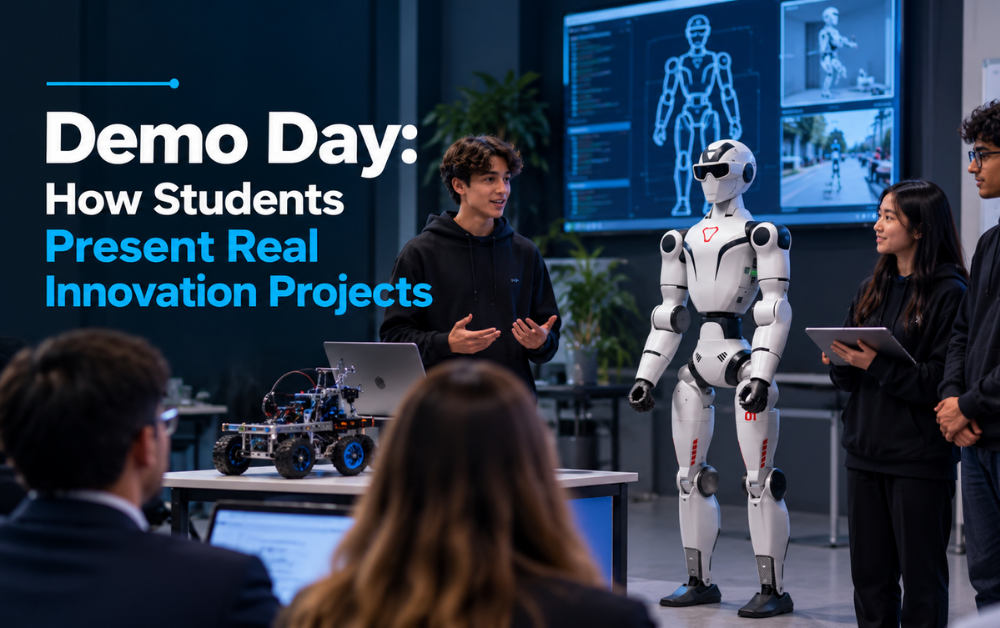
Building the robot is only half the project. At some point, a student has to stand in front of a room, explain what they made, and answer questions about it on the spot — no script, no do-overs.
At iCode Columbia, MD, that moment is Demo Day. Here’s what actually goes into getting a student ready to present real work to a real audience.
What Actually Happens on Demo Day
Demo Day isn’t a single formal event with a stage and a podium — it’s a working session where each student or team sets up their robot, walks through what it does, and takes real questions from the people watching.
It’s closer to a science fair than a graduation ceremony. Visitors move station to station, students repeat and adjust their explanation for each new audience, and by the third or fourth walkthrough most students have already found a clearer way to say something than they had the first time.
A Typical Demo Day Setup
- Each student or team sets up their robot at their own station
- Parents, peers, and mentors circulate and watch short walkthroughs
- Every presentation ends with unscripted questions from the audience
Preparing to Present: The Week Before
Presenting well doesn’t happen the morning of. The days leading up to Demo Day are where students turn a working project into something they can actually explain out loud, under time pressure, to people who weren’t there for the build.
Practicing the Pitch
Students run through their explanation multiple times before Demo Day — not to memorize a script, but to find the version of the explanation that actually makes sense to someone hearing it for the first time.
It’s common for a student to realize, mid-practice, that a detail they think is obvious isn’t obvious at all to someone outside the project. Catching that early is most of what practice is for.
Anticipating Tough Questions
Mentors push students to think through the questions an audience is likely to ask — especially the ones about parts of the project that didn’t go as planned. Being ready for that question matters more than having a perfect project.
Some of the most useful prep happens when a mentor plays a skeptical visitor on purpose, asking “why didn’t you just do it the simpler way?” until the student has an answer that holds up, not just a rehearsed line.
What Judges and Parents Actually Look For
An audience at Demo Day isn’t grading code quality line by line. They’re paying attention to whether a student understands what they built and can explain the reasoning behind it, not just the result.
Explaining the “Why,” Not Just the “What”
“It moves forward when it sees an object” is a description. “We chose this sensor because our first approach couldn’t tell distance accurately enough” is an explanation — and it’s the second one that shows real understanding.
Handling Questions on the Spot
The best answers on Demo Day aren’t always the most technical ones. A student who says “we tried that first and it didn’t work, here’s why” is showing more understanding than one who avoids admitting a dead end.
When a question catches a student off guard, the recovery matters more than the stumble. Pausing to think through an honest answer lands better than rushing to sound like they already knew.
When the Demo Doesn’t Go as Planned
Robots fail at the worst possible moments, including during a live demo. What separates a strong Demo Day from a rough one isn’t whether the robot cooperates — it’s how the student handles it when it doesn’t.
Recovering in Real Time
A student who calmly explains “here’s what should happen, and here’s what we’re still troubleshooting” comes across as more capable than one who panics over a glitch. Mentors coach students specifically on this ahead of time, because it’s almost guaranteed to come up for someone.
There’s usually a visible shift in the room when this happens well. A visitor who watches a student stay calm through an unexpected failure often comes away more impressed than if the robot had simply worked without a hitch — because the recovery is the harder skill to fake.
Why the Unitree R1 EDU Platform Gives Students Something Worth Presenting
A presentation is only as interesting as the project behind it. The Unitree R1 EDU platform gives students enough real capability that there’s something genuinely worth explaining on Demo Day, not just a script running in a simulator.
Quick Spec Snapshot
| Spec | Unitree R1 EDU |
| Weight | 25 kg |
| Degrees of Freedom | Up to 40 |
| Onboard Compute | NVIDIA Jetson Orin, 100 TOPS |
| Sensing | 3D LiDAR + depth cameras |
| Programming | Python / C++ via ROS 2 |
The Mentor’s Role Leading Up to Demo Day
Mentors at iCode Columbia, MD coach students on how to present, not what to say. Questions like “how would you explain that to someone who’s never seen the robot?” push students to find their own words instead of repeating a mentor’s.
Coaching Confidence, Not a Script
The goal isn’t a polished performance that sounds rehearsed. Mentors are more interested in whether a student can answer a question they didn’t expect than in whether their opening line sounds professional.
Why Presenting Matters as Much as Building
The World Economic Forum’s Future of Jobs Report 2025 estimates that 39% of core workplace skills will be disrupted by 2030 — and communication consistently ranks among the skills that stay valuable regardless of what technology changes around it.
A student who can explain their own work clearly and answer questions honestly is practicing exactly that skill, years before it shows up in a job interview or a work presentation.
It’s also a skill that transfers well beyond robotics. The same habits — knowing your material well enough to field an unexpected question, staying calm when something doesn’t go as planned — apply just as directly to a school presentation, a college interview, or a first job.
Frequently Asked Questions
What exactly happens on Demo Day?
Students set up their finished (or partially finished) robot project and walk an audience of parents, peers, and mentors through what it does, how they built it, and what they’d change with more time.
How long does each student get to present?
Presentation length is kept short enough to hold an audience’s attention while still leaving time for real questions — long enough to explain the project, not so long that it turns into a lecture.
What if the robot doesn’t work during the demo?
It happens, and it’s treated as part of the presentation. Students are prepared to explain what the project was supposed to do and what they’ve learned from the parts that aren’t working yet.
Do students write a script beforehand?
They prepare talking points, not a word-for-word script. Demo Day is meant to test whether a student actually understands their own project, which a memorized script doesn’t show.
Demo Day rewards the students who can talk about what didn’t work just as clearly as what did — and that kind of honesty under pressure is hard to fake and harder to teach any other way.
That’s the standard behind every presentation at iCode Columbia, MD.
For a closer look at how these presentations connect to the full program, visit the College Accelerator Program.