

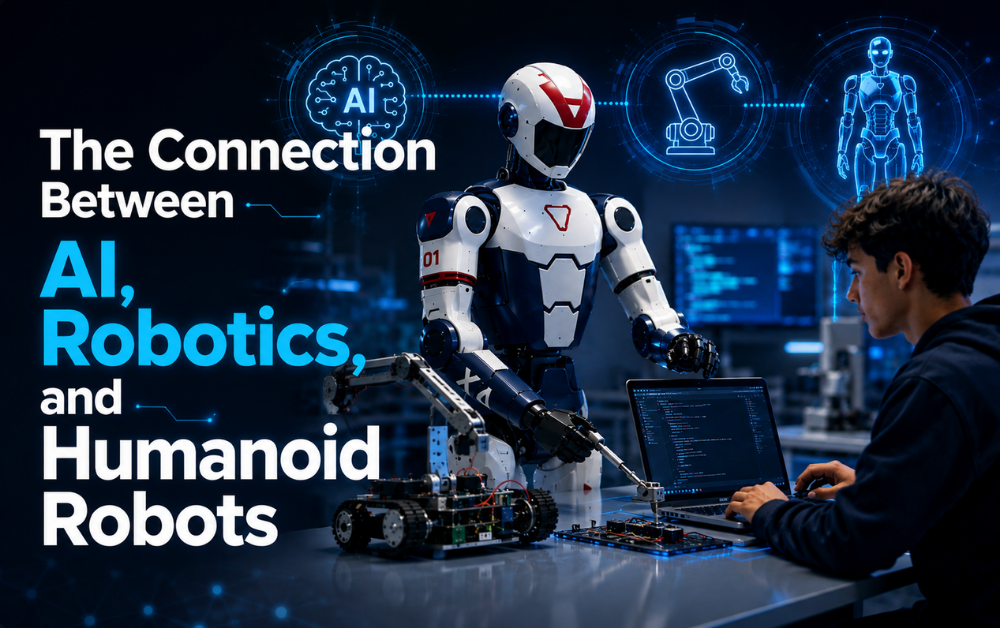
The Connection Between AI, Robotics, and Humanoid Robots — Explained for Columbia Students
Columbia sits close to one of the most concentrated technology and intelligence corridors in the country, and plenty of local families already work in fields that reward exactly the kind of systems-based thinking driving AI and robotics forward. At iCode Columbia, students get a hands-on, physical version of that thinking through a real working robot.
What Is AI, Really?
It’s Pattern Recognition, Not Magic
AI often gets talked about like it’s mysterious, but the underlying idea is fairly down to earth: a program that improves at a task by processing large amounts of example data, rather than being told exactly what to do step by step. Recognizing a face, translating a sentence, predicting the next move in a game — all pattern recognition, just at a scale humans can’t do by hand.
What Is Robotics?
The Physical Side of Smart Machines
Robotics is engineering, not software — the actual hardware that lets a machine sense and move through physical space. Wheels, joints, cameras, and motors all fall under robotics. None of that hardware knows what to do with what it senses, though, until something else makes the decisions.
How AI and Robotics Work Together
AI Is the Brain, Robotics Is the Body
This is exactly where AI and robotics meet. AI acts as the decision-making layer — the brain — while robotics provides the body that can actually carry out those decisions in the physical world. Neither one does much alone. A robot with no AI just repeats fixed motions. AI with no robot can only process data, never act on it.
Sensors, Decisions, and Action — All in Real Time
A robot’s usefulness depends on a fast, continuous loop: sensors collect data, AI processes it and decides on an action, motors carry it out — all repeated many times per second. That real-time decision-making loop mirrors the kind of systems work already common across the region, just applied to something that walks and moves.
What makes this connection worth understanding early is how widely it’s spreading. AI and robotics used to be separate specialties; now they overlap in fields from medicine to agriculture to manufacturing. Students who get comfortable with both at once are building a more versatile foundation than focusing on either alone.
Where Humanoid Robots Fit Into the Picture
Why the Human Shape Matters
Balance, Walking, and Adjusting on the Fly
Balancing on two legs is a continuous calculation, not a one-time fix. A humanoid robot recalculates its center of gravity and adjusts its footing constantly, correcting for uneven ground or an unexpected nudge.
Built to Work Alongside People, Not Replace Them
The human shape gives a robot a genuine practical advantage — it can move through spaces built for people and use tools built for human hands, without needing a custom environment designed around it.
How iCode Columbia Students Experience This Connection Firsthand
At iCode Columbia, students in the Youth Innovation Program — also known as the College Accelerator Program — work directly with a Unitree R1 EDU humanoid robot. It’s a 25-kilogram robot with up to 40 degrees of freedom, an onboard NVIDIA Jetson Orin AI computer running at 100 trillion operations per second, and 3D LiDAR paired with depth cameras for real-time sensing. Students code it themselves in Python and C++ through ROS 2.
A mentor leads the class — not the robot. Instructors cover the code, the mechanical systems that turn code into physical movement, and the sensor data the robot relies on to understand its surroundings.
The program runs as an 8-week, mentor-led cohort capped at 12 students, split into three teams of four to five. Robotics is one of several project paths, alongside web and mobile app development, data analysis, AI and automation, and digital media — but it’s the path that gives students hands-on access to hardware most people don’t encounter until well into a technical career. Every cohort finishes with a live pitch to iCode Corporate leadership.
Rather than starting with an ambitious final project, the program builds skills in layers over the eight weeks — movement and sensors first, then more complex decision-making once those fundamentals are solid. By the final weeks, teams are working through problems with real independence, not just following instructions.
Frequently Asked Questions
Does the robot teach the class?
No — a human mentor leads every session. The robot is the hands-on project, not a substitute for instruction.
Does my student need coding experience to join?
No prior experience is required. The program builds from the fundamentals through a full working project over eight weeks.
What programming languages are used?
Students write real code in Python and C++, working through the ROS 2 framework that controls the robot’s sensors and movement.
What happens at the end of the program?
Each team presents their finished project in a live pitch to iCode Corporate leadership, covering the build and the problems they solved.
Apply to the Youth Innovation Program at iCode Columbia
Seats are limited to keep the mentor-to-student ratio high. Visit iCode Columbia to learn more about the Youth Innovation Program and apply for the next cohort.