

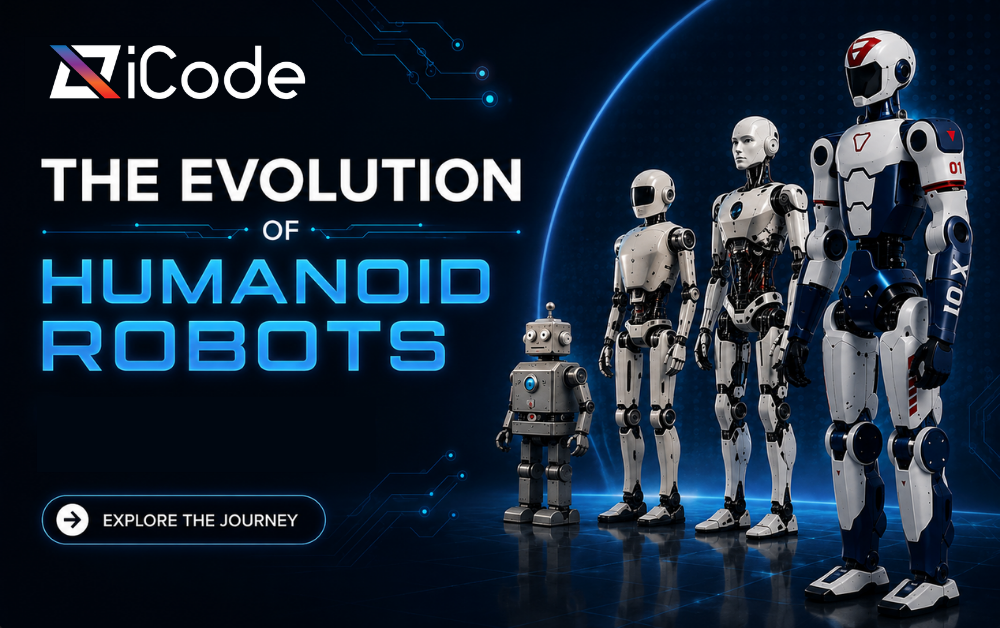
The Evolution of Humanoid Robots: From Science Fiction to STEM Education
A Planned Community, A Deliberate Program
Columbia was designed from the ground up to be a well-rounded place to raise a family, with strong schools built into that plan from the start. A hands-on humanoid robotics program fits the same philosophy — not an afterthought activity, but something built deliberately, with real structure and real equipment behind it.
What Students Actually Program
At iCode Columbia, that equipment is the Unitree R1 EDU, a 25-kilogram humanoid robot with up to 40 degrees of freedom, an onboard NVIDIA Jetson Orin AI computer capable of 100 trillion operations per second, and 3D LiDAR paired with depth cameras for sensing its environment. Every motion is controlled by code the student writes, in Python and C++ through ROS 2.
Staying Upright
A foundational project has students coding the robot to shift its weight and correct its posture after being gently nudged off balance — a problem that sounds simple but requires precise, fast-responding code. Early attempts often overcorrect, tipping the robot the other way. A mentor guides the student toward the specific value in their code that needs adjusting, rather than fixing it directly.
Overcorrection turns out to be the most common early mistake, and it’s an instructive one. A student’s first instinct is usually to respond to the nudge with a big, forceful correction, which just creates a new imbalance in the opposite direction. Learning to respond with a smaller, more measured adjustment — and to trust that a modest correction is often the right one — is a lesson that applies well beyond robotics.
The Instructor’s Role
That guidance matters because the robot isn’t the teacher. A mentor is present at every session, covering the code, the mechanical gears and linkages that turn code into motion, and the electronics tying sensors to the onboard computer.
The Youth Innovation Program
This is part of what iCode calls the Youth Innovation Program, also listed as the College Accelerator Program for the outcome it’s designed around. It’s an 8-week, mentor-led cohort capped at 12 students in three teams of four to five. Robotics is one available project path, alongside web and mobile app development, data analysis, AI and automation, and digital media, but it’s the one offering access to hardware few students see this early.
Ending With a Real Presentation
Every cohort finishes with a live pitch to iCode Corporate leadership, where students present their finished project and the reasoning behind their decisions.
Structure That Actually Produces Something
A lot of programs promise structure and deliver busywork instead. This one is judged by what a student can point to afterward: a working robot, a documented case study, and a presentation given to real company leadership, not just a completion certificate. That distinction matters to families who chose this community specifically because of how deliberately it was built — the program holds itself to the same standard.
No prior coding or robotics background is required to apply. The program starts with the fundamentals and builds from there, so a student’s starting point matters far less than their willingness to keep working through a problem until it’s solved.
Structurally, the eight weeks move through three stages: fundamentals first, then a longer stretch of building and testing where most of the real problem-solving happens, and a final period for refining the project and preparing the presentation to iCode Corporate leadership.
Columbia was planned around the idea that a good environment doesn’t happen by accident. This program was built with the same intent — real equipment, real mentorship, and a defined outcome, rather than a loosely structured activity that fills time without producing anything a student can point to afterward.
Twelve Seats, Real Structure
Enrollment is capped at 12 students so every one of them gets genuine mentor attention. If your student thrives with real structure behind a real challenge, apply to the Youth Innovation Program (College Accelerator Program) at iCode Columbia.