
Why We Brought Emerging Technologies Into Our Classrooms at iCode West Frisco
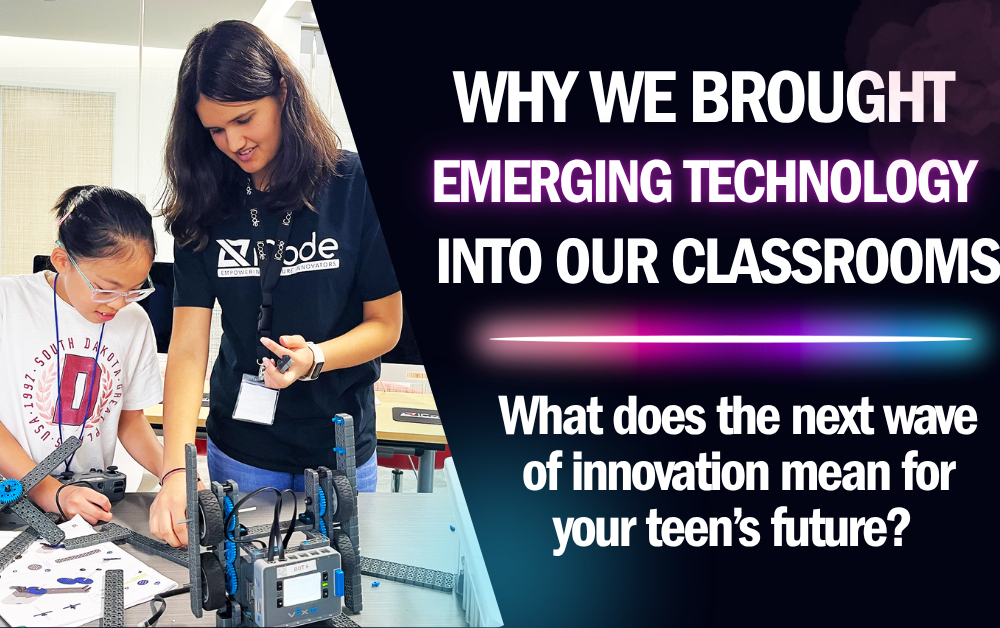
Ask what technology in education looks like, and many people picture a slideshow or a video. Those are easy to deliver and easy to forget. Our classrooms at iCode West Frisco take another route. Students use working tools directly and learn by doing. Teens in West Frisco, Little Elm, and Frisco can work with a real humanoid robot nearby.
The Difference Between Learning About Technology and Learning With It
Compare two experiences. In one, a student reads that a robot has sensors. In the other, the student moves a hand in front of a sensor and watches the reading change. The second one sticks.
Why Passive Learning Falls Short
Passive instruction has its place. Watching, reading, and listening all help. On their own, though, they do not build the comfort and fluency that come from operating a tool, making mistakes with it, and fixing them.
What Changes When Students Get Hands-On
Once students are responsible for making something work, their questions change. “What does this do?” becomes “Why is this not doing what I expected?” That is a far more useful question, and it builds real problem-solving.
What This Means for Your Teen’s Future
Skills That Outlast Any Single Tool
The robot or software a student learns on today may not be what they use in five years. The underlying skills will still apply. Troubleshooting, iteration, and comfort with new systems outlast any change around them.
A Head Start on the Habits Colleges and Employers Value
Students who have practiced working through practical technical problems with an experienced instructor tend to arrive at college coursework with more confidence. The same is likely true when they later enter the workplace, with fewer surprises.
Addressing a Common Parent Concern
Is This Just Another Screen-Time Activity?
Parents are right to ask. Passive screen time is watching. Here, students write code, run it on a physical robot, and fix what goes wrong. It is much closer to a lab class than a video game.
Balancing Structure With Genuine Curiosity
Good sessions need both structure and curiosity. Ours build skills progressively but leave room for students to solve problems themselves. That balance keeps interest high over time.
What Parents Can Expect to See Over Time
Across multiple sessions, a student who was reluctant to risk a wrong answer may become more willing to experiment. They may also need less reassurance when they troubleshoot.
A Long-Term Investment, Not a Quick Fix
None of this happens after a single session. Technical fluency and comfort with ambiguity build gradually, through repeated, guided practice. That is why the program is an ongoing progression rather than a one-time event.
What Parents May Notice Over Time
More Willingness to Try, Even When It’s Hard
Parents sometimes describe a change in how their teen approaches something unfamiliar. There is less hesitation and more willingness to try an approach, see if it works, and adjust if it does not.
Questions That Go Deeper
Students who have spent real time troubleshooting a piece of technology tend to ask sharper, more specific questions about how things work. They are less likely to accept a surface-level explanation.
Why This Shift Matters Beyond the Classroom
Curiosity and a troubleshooting instinct are useful far beyond the robot. They can help with schoolwork, hobbies, and eventually a job, regardless of the technology involved.
Less Fear of Getting It Wrong
The shift that may last longest is emotional. Practicing failure in a safe space, with a mentor close by, tends to reduce fear of the next unfamiliar challenge, technical or otherwise.
What This Looks Like in Our Classrooms
Real Robotics, Not Simplified Toys
Our Humanoid Robotics program puts students in front of genuine robotics hardware. They program it directly instead of working through a simplified simulation of what robotics might look like.
Instructors Who Guide, Not Just Demonstrate
Instructors at iCode West Frisco do more than demonstrate. They teach the concept first, then guide students as they apply it. The tool supports the learning. The teacher leads it.
Why Mentorship Still Matters Most
Tools alone do not teach thinking. Mentors do. A good mentor asks the right question at the right time and lets the student find the answer.
An Everyday Example
Picture a student whose code sends the robot the wrong way. The instructor guides the student through each step to find the cause. The student leaves able to debug the same problem independently.
Building Comfort With Change
Tools and challenges evolve from one session to the next. Students get used to not having the answer immediately. It is a habit that helps in many areas.
Our Approach Going Forward
Technology in education will keep changing, and so will our tools. We will keep one thing constant. Students will work with genuine tools, guided by experienced instructors, and do the work themselves.
Want to see it for yourself? The iCode West Frisco homepage shows the Humanoid Robotics program in action. For more on hands-on technology learning and long-term readiness, visit the College Accelerator Program page.
Frequently Asked Questions
Why not just teach technology concepts through lectures or videos?
A concept can be introduced in a lecture. Skill comes from using the tool. For that reason, every session is built around direct, guided use.
Do instructors still teach, or do students just work with the robot on their own?
Students are not on their own. An instructor leads each session and guides the work. The robot is the tool, and the instructor is the teacher.
Is this approach only useful for students interested in engineering?
Not at all. Problem-solving and adaptability help in nearly any field, so the approach is useful whatever a student plans to study.
How is this different from a typical school computer lab class?
Students work with real, current robotics hardware on guided projects over multiple sessions, rather than taking a single lesson on general computer skills.
Will the specific technology students learn on become outdated?
Individual tools may change over time. The underlying skills carry forward, whichever technology comes next. Those skills are troubleshooting, iteration, and adaptability.