
Scratch vs Python: Which Should Your Child Learn First?
With so many tech companies based right here in Alpharetta, it’s easy to assume every kid should jump straight into real code. The better question isn’t what looks most impressive, it’s what your child is actually ready for right now.
What Makes Python Different
Python looks like real code because it is real code, the same language used professionally to build websites, analyze data, and run AI systems. There’s no simplified version. Type a command wrong and you get an actual error message, and working through it is where a lot of the real learning happens.
Where the Learning Curve Comes In
The tradeoff is a steeper start. A missing colon or misaligned line can stop a program entirely, which can be discouraging for a child who isn’t ready for that kind of precision. That’s why timing matters so much when introducing it.
What Makes Scratch Different
Built for Beginners, Not Simplified
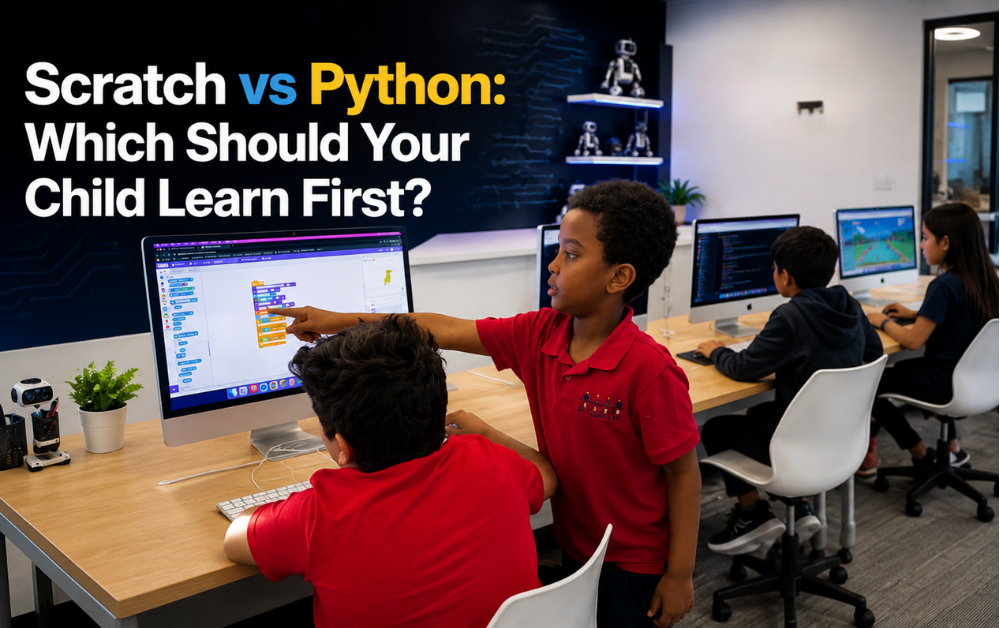
Scratch trades typed code for colorful, snap-together blocks, so a child can build a working animation or a simple game without a stray character breaking everything. It’s the same core logic, loops, conditionals, variables, just taught through an interface designed to make mistakes hard to cause and easy to see.
What Kids Actually Build With It
A Scratch session usually ends with something finished, an interactive story, a small game, an animated scene, often in one sitting. That completion matters for keeping a young learner motivated to come back.
So Which One Should Come First?
Generally, younger kids and true beginners get more out of starting with Scratch, since it builds real computational thinking without syntax errors in the way. Once a child is comfortable with loops and conditionals, or is a bit older and ready for more precision, Python becomes the natural next step. Some older, motivated kids skip Scratch entirely, which is fine too.
There’s no universal timeline for this transition. Some kids are ready for Python within a few months. Others benefit from a longer stretch in Scratch, sometimes a year or more, and come out just as prepared. Watch your child’s engagement more than the calendar.
Frequently Asked Questions
Is it fine to teach both languages together?
It’s possible, but it usually works better to get solid in one first. Learning a visual language and a typed one side by side early on can make both feel more confusing than either would be alone.
Can a young child handle Python?
It varies by child, but Python’s typed syntax rewards patience that younger kids haven’t always developed yet. Most families find eight or nine is the age where Python starts to click without a lot of frustration.
Does moving to Python mean my child starts from zero?
No. The core logic, loops, conditionals, variables, is the same in both. Only the format shifts, from snapping blocks to typing lines. That overlap is exactly why Scratch is considered good preparation rather than a detour.
How can I tell my child has outgrown Scratch?
Watch for a child breezing through Scratch projects and asking for more control than the blocks give them. That restlessness is usually the clearest sign that typed code will feel like a natural next step, not a struggle.
Find the Right Fit at iCode Alpharetta
Not sure which language is the right starting point? Our Belt Program meets a student exactly where they are. Book a free trial class at iCode Alpharetta and we’ll help you figure it out.