
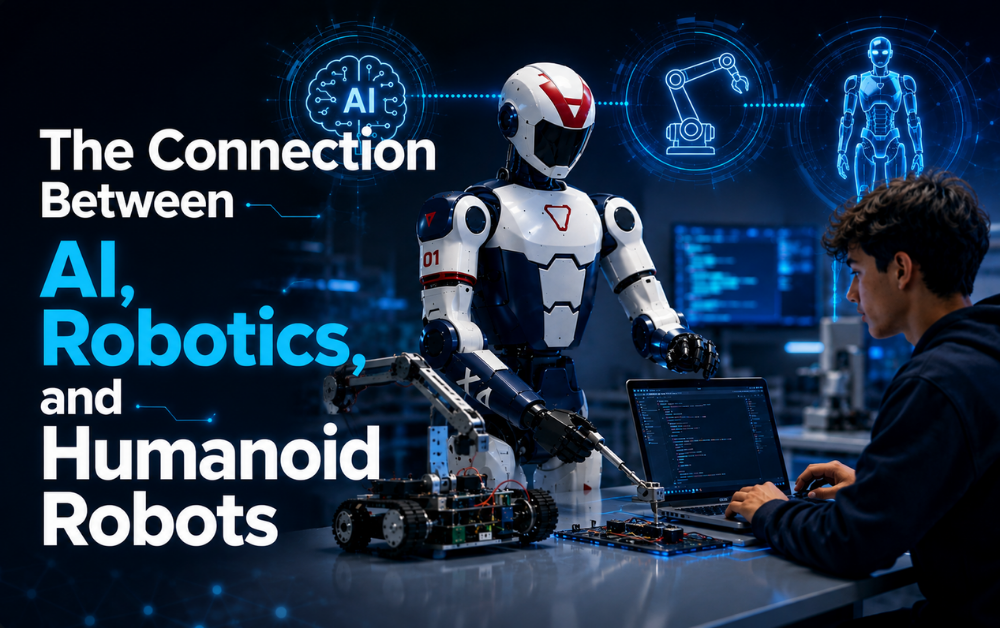
The Connection Between AI, Robotics, and Humanoid Robots — Explained for Ann Arbor Students
Ann Arbor is home to some of the most active autonomous vehicle and robotics research happening anywhere in the country, with the University of Michigan’s testing facilities right in town. At iCode Ann Arbor, students get a taste of that same research world — programming a real robot and watching AI decisions turn into physical movement.
What Is AI, Really?
It’s Pattern Recognition, Not Magic
At its core, AI is software that learns patterns from data rather than following a fixed script. Show it enough examples — pictures, sentences, sensor readings — and it starts recognizing patterns on its own. That’s the whole idea behind everything from spam filters to self-driving cars, just applied at different scales.
What Is Robotics?
The Physical Side of Smart Machines
Robotics is the physical half of the equation. It’s the engineering of machines that can sense their surroundings and move through the physical world — motors, gears, sensors, cameras, all working together. A robot without any intelligence behind it can still move, but it can’t make good decisions about how or when to move.
How AI and Robotics Work Together
AI Is the Brain, Robotics Is the Body
That’s the handoff between the two fields: AI decides, robotics acts. A robot’s sensors feed real-world information to its AI system, the AI processes that information and decides what to do, and the robot’s motors carry out the decision. Take either piece away and the system stops making sense.
Sensors, Decisions, and Action — All in Real Time
A robot’s usefulness comes down to a fast, continuous loop: sensors gather information, AI processes it and decides on an action, motors carry it out — all repeated many times per second. That’s the same core loop behind the autonomous vehicles being tested just down the road, scaled down to something students can actually build and debug themselves.
Understanding this connection early matters beyond any single class project. AI and robotics are increasingly showing up together across engineering, medicine, manufacturing, and logistics — fields that used to be considered separate now overlap constantly. A student who understands how the two connect has a real head start, whatever specific direction they eventually choose.
Where Humanoid Robots Fit Into the Picture
Why the Human Shape Matters
Balance, Walking, and Adjusting on the Fly
Balancing on two legs isn’t a one-time calculation — it’s continuous. A humanoid robot has to recalculate its center of gravity and adjust its footing constantly, correcting for shifts in the ground or an unexpected nudge.
Built to Work Alongside People, Not Replace Them
The human shape gives a robot a real practical advantage: it can move through spaces built for people and use tools built for human hands, without needing an entirely custom environment designed around it.
How iCode Ann Arbor Students Experience This Connection Firsthand
At iCode Ann Arbor, students in the Youth Innovation Program — also known as the College Accelerator Program — work directly with a Unitree R1 EDU humanoid robot. It’s a 25-kilogram robot with up to 40 degrees of freedom, an onboard NVIDIA Jetson Orin AI computer running at 100 trillion operations per second, and 3D LiDAR paired with depth cameras for real-time sensing. Students write the code themselves in Python and C++ through ROS 2.
A mentor leads the class — not the robot. Instructors cover the code, the mechanical systems that turn code into physical movement, and the sensor data the robot relies on to understand its surroundings.
The program runs as an 8-week, mentor-led cohort capped at 12 students, split into three teams of four to five. Robotics is one of several project paths, alongside web and mobile app development, data analysis, AI and automation, and digital media — but it’s the path that gives students hands-on access to hardware most people don’t encounter until well into a technical career. Every cohort finishes with a live pitch to iCode Corporate leadership.
The eight-week structure is intentionally gradual: early weeks cover the fundamentals of the robot’s movement and sensing, and later weeks add more complex, independent problem-solving on top of that foundation. Students aren’t expected to arrive already knowing how any of it works.
Frequently Asked Questions
Does the robot teach the class?
No — a human mentor leads every session. The robot is the hands-on project, not a substitute for instruction.
Does my student need coding experience to join?
No prior experience is required. The program builds from the fundamentals through a full working project over eight weeks.
What programming languages are used?
Students write real code in Python and C++, working through the ROS 2 framework that controls the robot’s sensors and movement.
What happens at the end of the program?
Each team presents their finished project in a live pitch to iCode Corporate leadership, covering the build and the problems they solved.
Apply to the Youth Innovation Program at iCode Ann Arbor
Seats are limited to keep the mentor-to-student ratio high. Visit iCode Ann Arbor to learn more about the Youth Innovation Program and apply for the next cohort.