

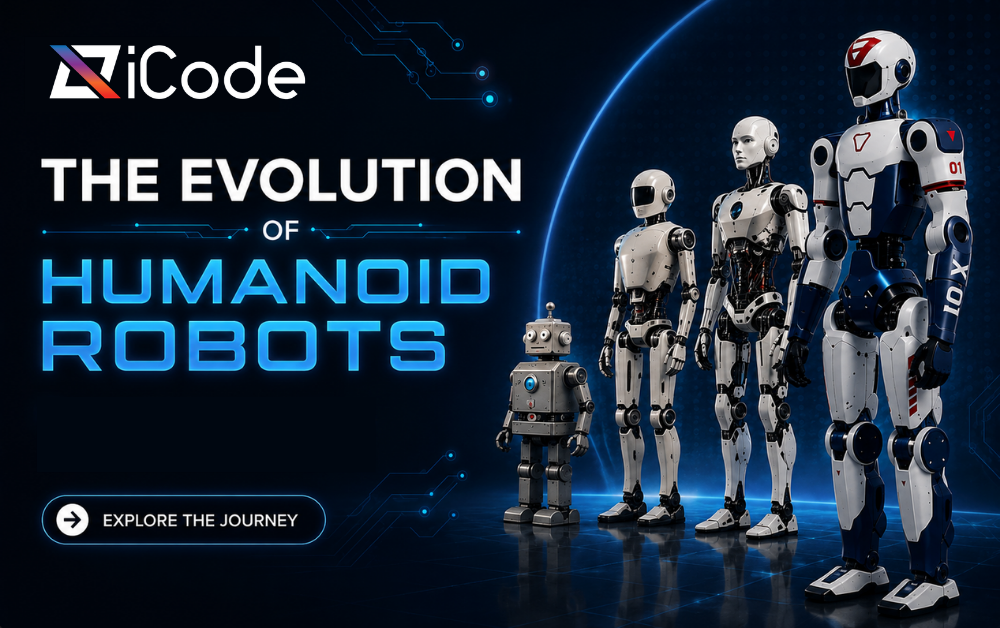
The Evolution of Humanoid Robots: From Science Fiction to STEM Education
A Research Town, One Generation Down
Ann Arbor has built its identity around research for generations, largely because of the university at its center. A lot of local students already grow up around people who build and test things for a living. A hands-on robotics program fits naturally into that environment — it just gives a teenager the chance to do that kind of work directly, years before college.
The Robot iCode Ann Arbor Actually Uses
iCode Ann Arbor’s Youth Innovation Program gives students hands-on time with the Unitree R1 EDU, a 25-kilogram humanoid robot built for research and STEM education. It moves with up to 40 degrees of freedom, meaning roughly 40 separate joints and points of articulation, runs on an onboard NVIDIA Jetson Orin AI computer capable of 100 trillion operations per second, and uses 3D LiDAR and depth cameras to sense its surroundings in real time. Students program it directly in Python and C++ through ROS 2, the same robotics framework used in professional labs.
It’s Worth Being Precise About Who Teaches
It’s easy to assume the robot does the teaching. It doesn’t. iCode instructors teach the students — how to write the code that controls each joint, how the mechanical gears and linkages turn that code into movement, and how the electronics underneath tie it all together. The robot is the subject and the equipment. The teaching comes from the mentors guiding each session.
Inside the Youth Innovation Program (College Accelerator Program)
iCode calls this the Youth Innovation Program, though you’ll also see it listed as the College Accelerator Program — a name that says exactly what it delivers. Either way, it’s the same 8-week, mentor-led cohort. Each group is capped at 12 students, split into three teams of four to five. Working with the humanoid robot is one of several project paths a student can choose — others include web and mobile app development, data analysis, AI and automation, and digital media — but the robot is the option that gives students access to hardware and software they genuinely cannot get anywhere else at this age.
Every cohort ends the same way: a live pitch to iCode Corporate leadership, where each team presents what they built and explains the decisions they made along the way.
What a Student Actually Learns
Picture a student trying to get the robot to turn and pick up an object. The first version of their code usually doesn’t work exactly right — maybe the arm stops short, or the turn overshoots. Instead of being handed the fix, the student has to trace back through the code, figure out which instruction caused the mismatch, and adjust it. That loop of testing, failing in a specific way, and correcting it, guided by a mentor rather than solved for them, is where most of the actual learning happens.
Beyond the robot itself, a student walks away with a specific set of skills. They practice real programming, since every motion the robot performs is code they wrote themselves. They pick up practical mechanical understanding, seeing how gears, joints, and linkages work together to create movement. They get exposure to real electronics, connecting sensors and onboard computers to a working mechanical system. And they build a documented, portfolio-ready project, complete with a case study and a presentation, which is exactly the kind of concrete proof that turns a college application into a specific story instead of a list of grades.
Join the Youth Innovation Program at iCode Ann Arbor
A research town raises students who are comfortable asking why something didn’t work instead of just accepting that it didn’t. That instinct is exactly what this program is built around — not handing students answers, but giving them a real problem, real equipment, and a mentor who helps them find the answer themselves.
Enrollment is intentionally small, 12 seats per cohort, so mentors can work closely with every student. If your teenager wants something real to show for their work, not just another line on a resume, apply to the Youth Innovation Program (College Accelerator Program) at iCode Ann Arbor today.