
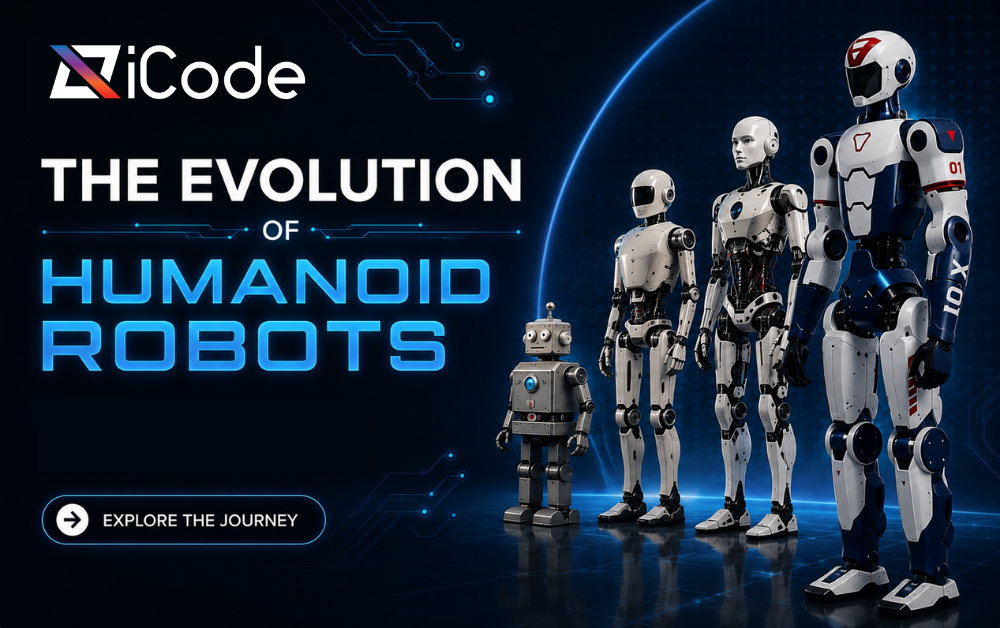
The Evolution of Humanoid Robots: From Science Fiction to STEM Education
Riding the Edge of Austin’s Growth
Leander has grown fast largely because of its proximity to Austin’s tech industry, and a lot of families here moved specifically to be near that kind of opportunity. A hands-on robotics program extends that same logic to their kids — real access to the technology shaping the region’s economy, not just a general STEM class.
What the Robot Can Actually Do
Students at iCode Leander work with the Unitree R1 EDU, a 25-kilogram humanoid robot with up to 40 degrees of freedom, an onboard NVIDIA Jetson Orin AI computer running at 100 trillion operations per second, and 3D LiDAR paired with depth cameras for sensing its environment. The code that controls it, written in Python and C++ through ROS 2, comes entirely from the student.
Two Arms, One Task
A more advanced project has students coordinating both of the robot’s arms to lift and carry an object between them, which requires the two arms to move in sync rather than independently. The first attempt usually has one arm lag behind the other, tipping the object. Instead of a mentor stepping in to fix the timing directly, the student is guided to find where the two sequences fall out of sync and correct it themselves.
The instinct for most students is to speed up the slower arm until it matches. That works, but only up to a point — eventually the student has to understand why one arm was lagging in the first place, whether it’s a difference in the code, the mechanics, or both. That deeper question, asked by the mentor rather than answered outright, is usually where the real understanding sets in.
Instructors, Not Automation
A mentor runs every part of this — the code, the mechanical gears and linkages that translate instructions into motion, and the electronics connecting the robot’s sensors to its onboard computer. The robot doesn’t explain any of this on its own.
The Youth Innovation Program
This is part of what iCode calls the Youth Innovation Program, also referred to as the College Accelerator Program for the outcome it produces. It’s an 8-week, mentor-led cohort capped at 12 students in three teams of four to five. Robotics is one path among several — web and mobile app development, data analysis, AI and automation, and digital media are also options — but it offers access to hardware students can’t get almost anywhere else this early.
The Finish: A Live Pitch
Every cohort wraps up with a presentation to iCode Corporate leadership, where students present their finished work and answer real questions about the choices they made.
More Than Proximity to Austin
Living near a strong tech market gets a student exposure, but exposure isn’t the same as experience. What actually shows up on a resume or an application is proof of work — a project a student built, debugged, and can explain in detail. That’s what separates a Leander student who grew up near this industry from one who actually practiced the skills it runs on, hands-on, over eight real weeks with a mentor checking their work.
Applicants don’t need to already know how to code. The program is built to take a motivated beginner through the fundamentals first, then into the harder project work — proximity to a tech hub helps with interest, not with the actual starting skill level.
The pacing is deliberate: early weeks cover fundamentals, the middle stretch is for building and testing the real project, and the final weeks are reserved for polishing the work and preparing the pitch to iCode Corporate leadership.
Twelve Seats, Filling Fast
With only 12 seats per cohort, spots go quickly. If your student wants hands-on time with the kind of technology shaping this region, apply to the Youth Innovation Program (College Accelerator Program) at iCode Leander.