
What Kind of Projects Can Students Build with a Humanoid Robot?
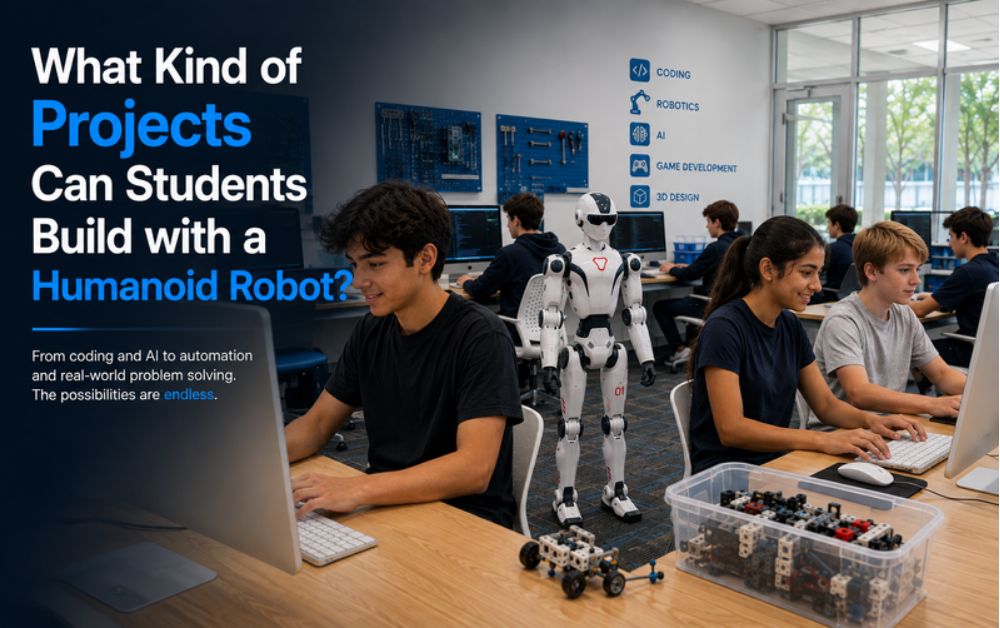
On the edge of the Austin tech corridor, Leander students get to build the same category of hardware project showing up throughout that industry.
A humanoid robot isn’t just something to watch move — it’s a platform students actually build on. From a first walking test to a full choreographed routine, here’s what that progression actually looks like.
Real Projects Start With Movement
Getting the Robot to Hold Its Balance
Early projects usually start with movement — programming the robot to walk forward, turn, and stop at a marked point without losing its balance. That simple task hides a lot of coordination: dozens of joints working together, adjusting in real time as the robot shifts its weight.
Giving the Robot a Way to See
Sorting Objects Using the Robot’s Cameras
The next kind of project shifts from movement to perception. Using the robot’s built-in cameras, students teach it to recognize a specific object among several others and respond accordingly.
How Students Build This, Step by Step
The process usually breaks into four parts: setting the target to identify, writing the logic that scans for it, testing until the detection is reliable, and adding the movement that follows once the robot makes its decision.
Projects Built Around Interaction
Programming a Response to a Command
Rather than working with objects, this kind of project has the robot respond to a person directly: a command triggers a reaction, whether that’s a turn, a wave, or a full stop.
Creating a Simple Tour Sequence
More advanced students combine sensing and movement into a follow-me routine, where the robot tracks a person and stays a set distance behind — or builds out a short guided tour that stops at marked points along the way.
Advanced Projects Students Design Themselves
Programming a Full Routine
By the end of the program, many students design their own choreographed routine — a sequence of steps, turns, and gestures timed together, similar to programming a short dance.
Navigating a Custom Course
Some students prefer a navigation challenge — building a small course of obstacles and programming the robot to sense and avoid each one instead of walking a single memorized path.
Where Leander, TX Students Actually Build These Projects
Inside the Program
At iCode Leander, these projects come from the Youth Innovation Program, an eight-week, mentor-led course built around hands-on work with a real humanoid robot platform.
What Students Take Away From Building These
None of these projects stay contained to robotics — the habits behind them carry much further.
- Breaking a big idea into small, testable steps
- Debugging calmly when a project doesn’t work the first time
- Understanding how sensors, code, and movement connect
- Presenting a finished project and explaining how it works
Frequently Asked Questions
Do students design their own projects, or follow a set list?
Both. Early sessions introduce structured projects to build core skills, and later sessions give students room to design their own variations or combine ideas.
What programming languages are used for these projects?
Students work in Python and, for more advanced projects, C++ through ROS 2 — the same tools used in real robotics development.
Does a student need prior coding experience to start?
No. Projects are introduced in order of difficulty, and a mentor guides students through the basics before any advanced work begins.
Can younger students handle projects like these?
Yes. Projects are scaled to the student’s level, starting with simple movement tasks and building toward sensor-based and interactive projects as skills grow.
Curious what your student in Leander could build? Learn more at iCode Leander.