
Why Students Learn Better with Hands-On Technology Like Humanoid Robots
Leander has grown fast largely because of its proximity to Austin’s tech industry, and a lot of local families moved specifically to be near that kind of opportunity. Hands-on learning extends that same access directly to their kids.
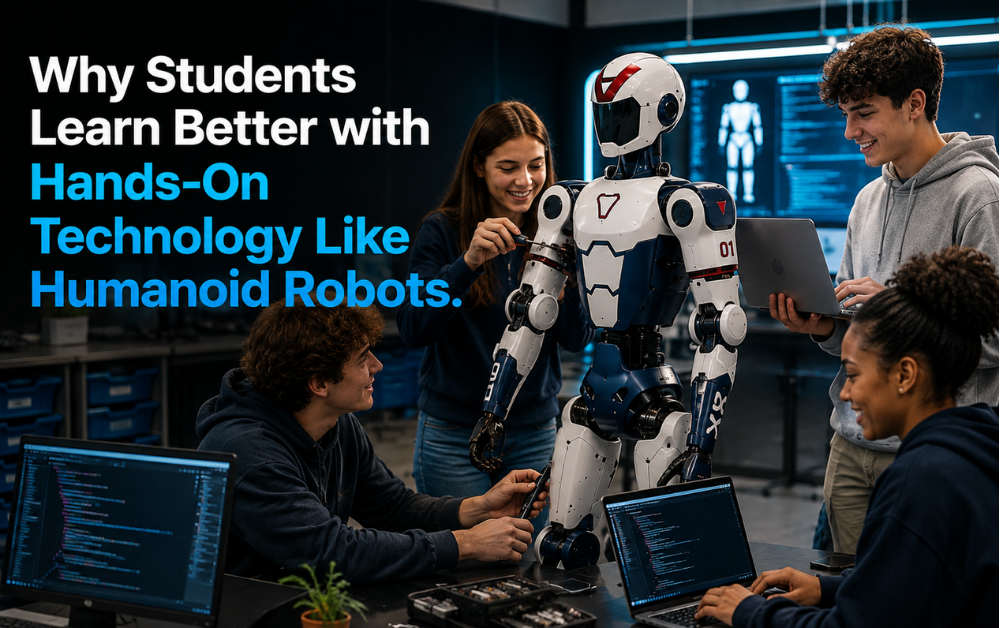
At iCode Leander, students build with technology instead of just reading about it, and when that technology is a real humanoid robot, the lesson sticks in a way no lecture can match.
Why Doing Beats Watching
This isn’t just intuition. Applying a concept produces stronger recall than simply hearing about it, since doing something forces the brain to process it differently than passive listening does. That’s the whole design behind the Youth Innovation Program, where every concept gets tested by hand, not just explained.
A student who only hears how two robotic arms coordinate to lift something might remember a term for a quiz. A student who writes the code, watches one arm lag, and figures out why remembers it for years.
A Robot That Doesn’t Cooperate (At First)
Here’s what that looks like in practice. A student is coordinating both of the robot’s arms to lift and carry an object between them, which requires the two arms to move in sync. The first attempt usually has one arm lag behind the other, tipping the object.
Nobody hands over the fix. A mentor asks pointed questions: which sequence is out of sync? What happens if you adjust the timing? The student tests an idea, watches it fail differently, and tries again. That loop is most of where the real learning happens.
By the third or fourth attempt, something shifts. The student stops waiting to be told what’s wrong and starts predicting it themselves. That shift is the actual milestone.
The Skills That Actually Stay With Them
Zoom out far enough and none of this is really about robots. A student who spends eight weeks debugging a robot’s coordinated movement walks away with faster recall, since ideas tied to something they built stick better than ideas they only heard. They build real troubleshooting skill, the ability to isolate what’s wrong instead of guessing. They get comfortable with unfamiliar tools, which outlasts any single piece of software. And they finish with a project they can explain start to finish.
Recall, troubleshooting, adaptability, and ownership are the actual product here. The robot is just an unusually effective way to build them.
Where This Happens: The Youth Innovation Program
At iCode Leander, this hands-on approach is built into the Youth Innovation Program, also called the College Accelerator Program. It’s an eight-week, mentor-led cohort capped at 12 students, working in teams of four or five. Robotics is one path among several, but it’s the one that puts real hardware, real sensors, and real code directly in a student’s hands.
Worth being direct about one thing: the robot doesn’t teach the class. A mentor does, every session, walking students through the code, the mechanics, and the electronics underneath. The robot is what students learn on, not what teaches them.
Every cohort finishes with a live pitch to iCode Corporate leadership, where students present their project, including what didn’t work at first.
Frequently Asked Questions
Does my student need coding experience to join?
No. Most students start with basic school-level coding at most, or none at all. The first sessions are built around getting everyone to the same starting point before the harder project work begins.
Is working with a real robot safe for a teenager?
Yes. The robot is used under direct mentor supervision at every session, and the projects are scoped to what a student can safely control and test.
How is this different from a typical coding class or camp?
A typical class teaches a concept and moves on. This program is built around one extended project over eight weeks, with a mentor guiding students to debug their own mistakes rather than simply demonstrating the right answer.
What if the project doesn’t fully work by the end of the eight weeks?
That happens, and it’s fine. The final presentation to iCode Corporate leadership includes explaining what didn’t work and why, which is often the most impressive part of the pitch, not a weakness in it.
Give It a Try
If your student wants hands-on time with the kind of technology shaping this region, take a look. Cohorts fill fast at just 12 seats. Book a free trial class at iCode Leander and see it for yourself.