

The Connection Between AI, Robotics, and Humanoid Robots — Explained for Redmond Students
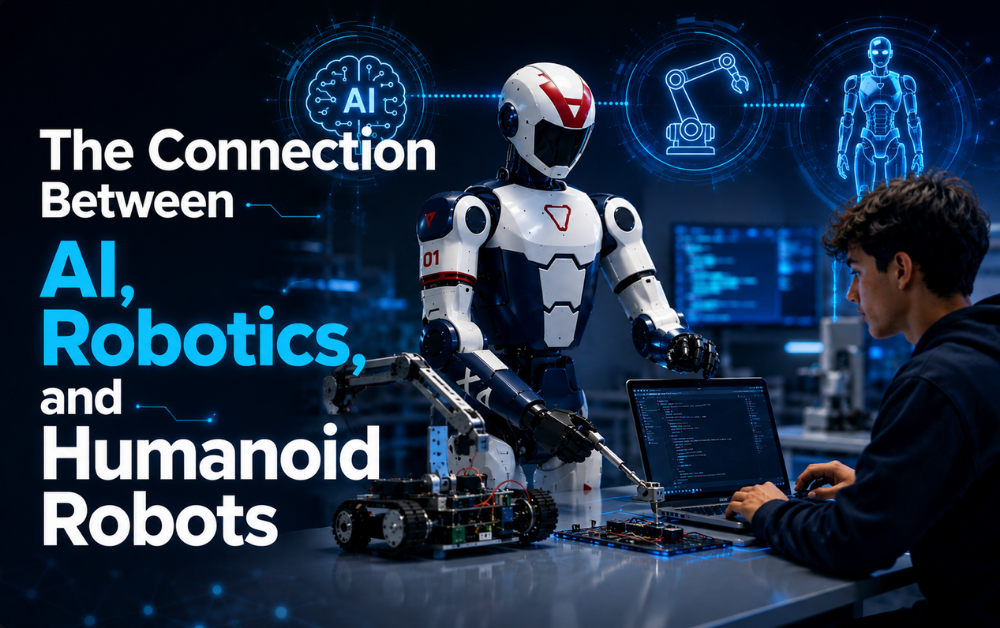
Redmond is home to one of the largest AI research operations in the world, and plenty of local students already have a parent or neighbor working somewhere in that world. At iCode Redmond, that same AI conversation gets a hands-on, physical counterpart — instead of just talking about how AI works, students program a real robot and watch the decisions play out in the physical world.
What Is AI, Really?
It’s Pattern Recognition, Not Magic
Strip away the buzzwords, and AI is really just software that learns from examples instead of following a fixed set of instructions. Feed it enough images of stop signs, and it learns to recognize a stop sign. Feed it enough sentences, and it learns to predict what word comes next. It’s pattern recognition, scaled up.
What Is Robotics?
The Physical Side of Smart Machines
Robotics covers the physical side: the motors, joints, sensors, and structure that let a machine interact with the real world. A robotic arm can lift something the instant it’s told to. What robotics alone can’t do is figure out what to lift, when, or how to adjust if something changes.
How AI and Robotics Work Together
AI Is the Brain, Robotics Is the Body
This is the connection point: robotics builds the body, AI builds the mind, and a working robot needs both running together in real time. Sensors gather information, AI processes it and decides on an action, and the robot’s motors execute that decision — all in a continuous loop, many times per second.
Sensors, Decisions, and Action — All in Real Time
A voice assistant only has to process language and respond with more language — a fairly contained loop. A robot has to process sensor data, decide on a physical action, and execute that action safely, all while conditions keep changing around it. That’s a much harder real-time problem, and it’s part of why robotics is considered one of the more demanding applications of AI.
The overlap between AI and robotics keeps growing across industries that used to operate independently — healthcare, agriculture, manufacturing, logistics. A student who understands that connection isn’t just learning a niche skill; they’re picking up a foundation that shows up in a widening range of technical fields.
Where Humanoid Robots Fit Into the Picture
Why the Human Shape Matters
Balance, Walking, and Adjusting on the Fly
Legs are much harder to balance than wheels. A humanoid robot has to constantly recalculate its center of gravity and adjust its footing the moment something shifts — a person walking by, an uneven surface, a slight nudge. That real-time balancing act is one of the hardest unsolved problems in robotics.
Built to Work Alongside People, Not Replace Them
The human shape exists for a practical reason: it lets a robot move through spaces built for people and use tools built for human hands, without needing an entirely separate environment designed around it. That’s the whole point of building a robot shaped like us instead of a wheeled cart.
How iCode Redmond Students Experience This Connection Firsthand
At iCode Redmond, students in the Youth Innovation Program — also called the College Accelerator Program — work directly with a Unitree R1 EDU humanoid robot. It’s a 25-kilogram robot with up to 40 degrees of freedom, an onboard NVIDIA Jetson Orin AI computer running at 100 trillion operations per second, and 3D LiDAR paired with depth cameras for real-time sensing. Students write the controlling code themselves in Python and C++ through ROS 2.
An instructor leads every session — the robot doesn’t teach itself, and it doesn’t teach the students either. Mentors walk through the code, the mechanical systems that turn code into movement, and the sensor data the robot uses to understand its surroundings.
The program runs as an 8-week, mentor-led cohort capped at 12 students, split into three teams of four to five. Robotics is one of several project paths, alongside web and mobile app development, data analysis, AI and automation, and digital media — but it’s the path that puts genuinely advanced hardware directly in students’ hands. Every cohort ends with a live pitch to iCode Corporate leadership.
Projects don’t start at full complexity — the eight weeks are structured so students build core skills first (basic movement, reading sensor data) before tackling more ambitious, independent problem-solving in the later sessions. That gradual build is intentional, so no student feels lost early on.
Frequently Asked Questions
Does the robot teach the class?
No — an instructor leads every session. The robot is the project students build and program, not a stand-in for a teacher.
Is prior coding experience required?
No. The program starts from the fundamentals and builds toward a real working project over eight weeks.
What does the robot’s onboard AI actually do?
The NVIDIA Jetson Orin module processes sensor data in real time, so the robot can perceive its surroundings and make decisions without relying on a separate external computer.
How is a project team structured?
Cohorts are capped at 12 students, split into three teams of four to five, each working through the project together with mentor guidance.
Apply to the Youth Innovation Program at iCode Redmond
Spots fill quickly given the small cohort size. Visit iCode Redmond to learn more about the Youth Innovation Program and apply.