

The Evolution of Humanoid Robots: From Science Fiction to STEM Education
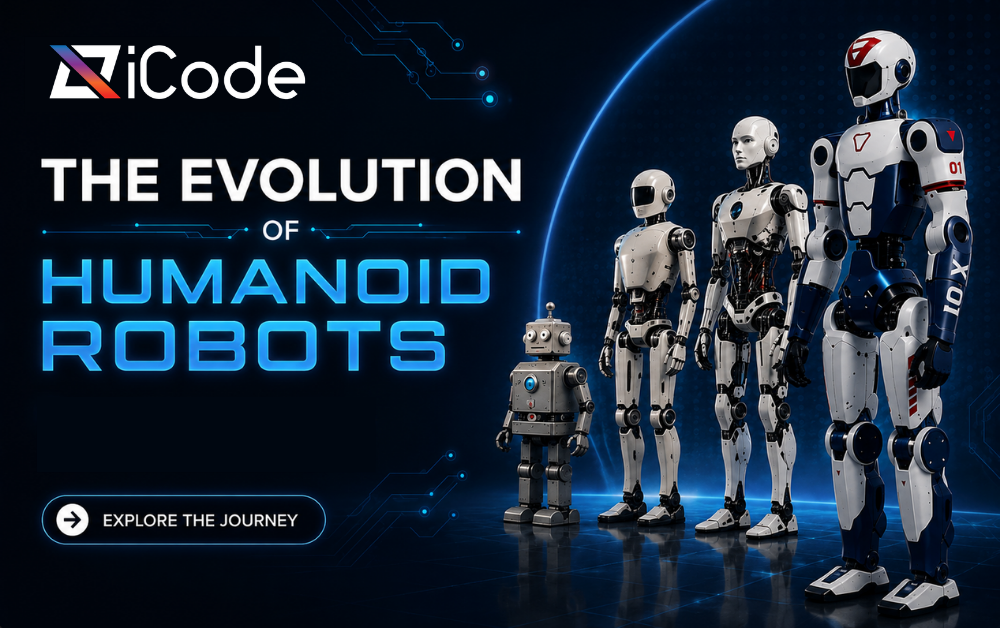
Growing Up Near the Source Code
A kid in Redmond has probably had someone in their life work on software that runs on a billion devices — it’s just part of living this close to the center of the Puget Sound tech industry. That proximity changes what feels normal to a student here. Writing code that controls a physical machine isn’t an abstract idea; it’s the kind of work that happens down the street.
What a Student Actually Learns to Program
At iCode Redmond, students get hands-on time with the Unitree R1 EDU, a 25-kilogram humanoid robot with up to 40 degrees of freedom, an onboard NVIDIA Jetson Orin AI computer capable of 100 trillion operations per second, and 3D LiDAR with depth cameras for sensing its surroundings. The code is written by the student, in Python and C++ through ROS 2, the same framework professional robotics teams use.
Here’s the part worth being direct about: the robot isn’t the one teaching. A mentor is. Every session, an instructor walks students through the code, the mechanics — how gears and linkages turn that code into physical motion — and the electronics connecting sensors to onboard computing. The robot is what a student learns on. The teaching comes from the person standing next to them.
Try This: Get the Robot to Respond to What It Sees
One common project has a student programming the robot to track an object moving in front of its cameras and turn to follow it. The first version of the code is almost never right — it lags behind the object, or overcorrects and overshoots. Rather than being handed the fix, the student works with a mentor to isolate which part of the code is causing the delay and adjusts it. That back-and-forth between writing, testing, and fixing is most of what the eight weeks actually consist of.
What makes this different from a typical coding class is the physical feedback. A bug in a web app might just produce an error message. A bug in this project makes the robot visibly turn the wrong way, or too slowly, or not at all — which gives a student an immediate, obvious signal that something needs fixing, long before a mentor has to point it out. That immediacy is part of why the lesson tends to stick.
The Program Underneath the Robot
This falls under what iCode calls the Youth Innovation Program — also listed as the College Accelerator Program, since that’s what it’s ultimately building toward. It’s an 8-week, mentor-led cohort, capped at 12 students working in three teams of four to five. A student can choose robotics as their project, or opt into web and mobile app development, data analysis, AI and automation, or digital media instead. Robotics is simply the path that puts a student in front of hardware they can’t access anywhere else at this age.
Ending With Something Real
Every cohort finishes with a live pitch to iCode Corporate leadership. Students don’t just show a finished robot — they present a case study, explain what didn’t work at first, and walk through how they solved it. That combination of a working project and the ability to explain it is exactly what turns a college application into something specific instead of a list of activities.
A Different Kind of Advantage
Growing up around a major tech industry gives Redmond students a head start in one sense — familiarity — but familiarity alone doesn’t show up on a college application. What does is proof: a project a student built, broke, and fixed themselves, with a mentor who can speak to exactly how they worked through it. That’s a different kind of credential than knowing the industry exists nearby. It’s evidence a student can actually do the work, not just describe it.
Twelve Students, Real Attention
Each cohort is capped at 12 seats so mentors can work closely with every student rather than managing a large group from a distance. If your student is ready to write code for something that actually moves, apply to the Youth Innovation Program (College Accelerator Program) at iCode Redmond.