

What Shrewsbury Kids Really Take Away From Coding Class
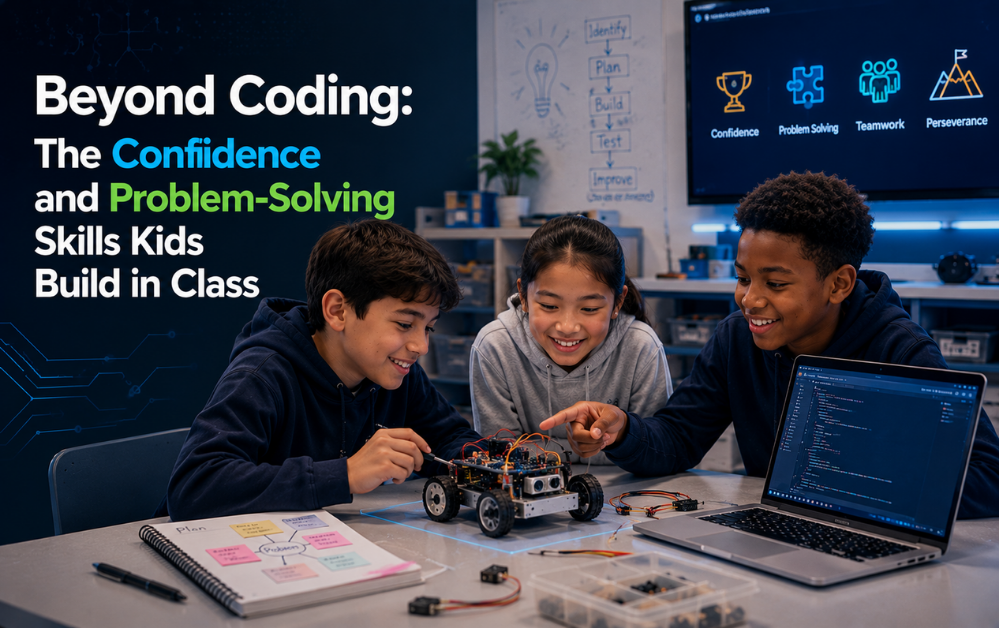
Shrewsbury sits near a growing biotech and healthcare corridor, full of families who understand that future careers reward people who think through problems methodically, not just memorize answers. At iCode Shrewsbury, that’s exactly the muscle coding builds, alongside confidence, teamwork, and perseverance.
Every Project Follows the Same Process
Instead of jumping straight into code, students work through the same five-step cycle real engineers use: Identify, Plan, Build, Test, Improve, the same kind of methodical process that runs through so many local careers.
Identify — Naming the Real Problem
Before any code gets written, a student defines exactly what the project needs to accomplish. That upfront clarity, instead of guessing and hoping, is the first real problem-solving skill the class builds.
Plan — Mapping It Out First
With the goal defined, students sketch the steps before touching a keyboard, breaking a big challenge into smaller, testable pieces. Shrewsbury parents often notice this same pattern show up in a tough math problem or a research project.
Build — Bringing the Plan to Life With a Partner
Many projects are built with a partner, and this is where teamwork becomes a real, practiced skill. Students split tasks, combine two different approaches into a single working result, and have to communicate clearly enough that both halves fit.
Test — Why Every Bug Is Actually Good News
When code doesn’t run, that’s not a dead end, it’s information. Instructors teach students to narrow down the cause instead of getting frustrated and starting over. Over time, that shifts how kids relate to mistakes generally, from something to avoid, to something to investigate.
Improve — Presenting and Owning the Fix
Most units end with students presenting their work: what it does, what went wrong, and how they solved it. A student doesn’t need a perfect project to give a strong presentation, they need to understand what they built well enough to talk about it clearly, a skill that transfers to school presentations and eventually job interviews.
Why the Progression Matters as Much as Any Single Class
Classes are structured to build on themselves through the Belt Program, our curriculum, where each unit introduces a slightly harder challenge, so skills compound gradually instead of appearing all at once.
Frequently Asked Questions
Does this class only teach coding, or is there more to it?
Coding is really just the vehicle. The class is deliberately structured around the Identify, Plan, Build, Test, and Improve cycle to build confidence, problem-solving, teamwork, and perseverance right alongside it.
My child shuts down when frustrated. Is this a good fit?
It can be one of the better environments for a child like that. The Test step is built to guide a student through frustration step by step, with a mentor there to help instead of leaving a student stuck alone.
Is this a solo activity, or do kids work together?
Both happen. Planning tends to start individually, but the Build step is done with a partner or small team, and that’s where most of the teamwork and communication practice comes from.
How soon does a parent typically notice a difference?
Usually within the first few weeks, often in how a child reacts to a hard problem at home, well before a project is fully finished.
See a Class for Yourself
Confidence isn’t something you can lecture a child into, it’s something they build by solving real problems, one at a time. Book a free trial class at iCode Shrewsbury, a low-pressure way to see if this approach fits your child.