

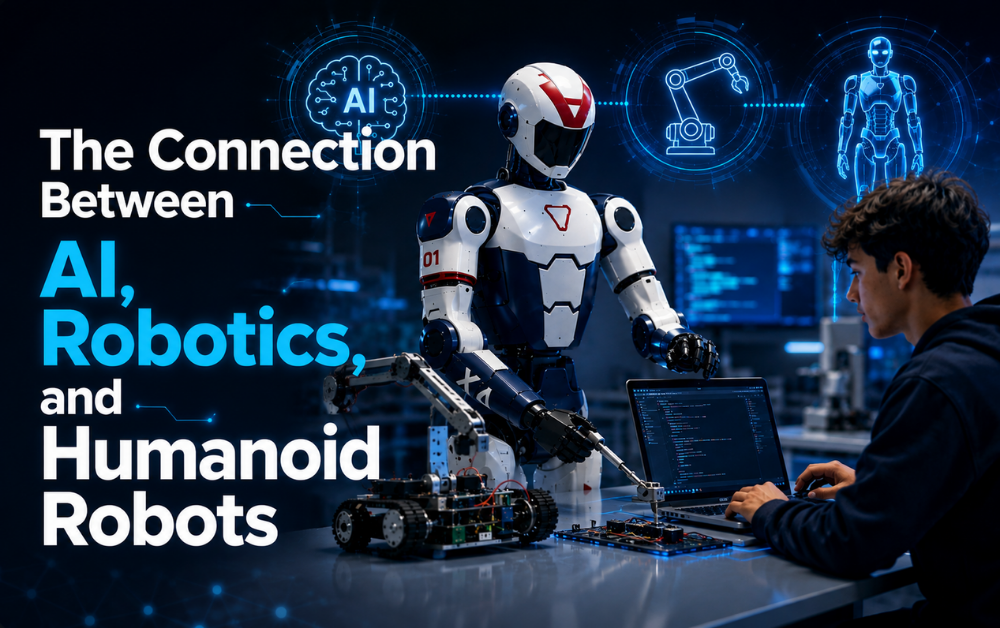
The Connection Between AI, Robotics, and Humanoid Robots — Explained for Southlake Students
The DFW area has a deep aerospace and defense engineering history, full of families who understand just how much careful, systems-based thinking goes into building something that has to work reliably in the real world. At iCode Southlake, students get an early, hands-on version of that same engineering discipline, applied to AI and robotics.
What Is AI, Really?
It’s Pattern Recognition, Not Magic
AI sounds complicated, but the core idea is simple: it’s software that gets better at a task the more examples it sees. A chess AI improves by studying thousands of games. A voice assistant improves by hearing thousands of sentences. There’s no magic involved — just pattern recognition happening at a scale no human could match by hand.
What Is Robotics?
The Physical Side of Smart Machines
If AI is about thinking, robotics is about doing. It’s the design and engineering of machines that can sense the world around them and act on it — arms that grip, wheels that roll, legs that walk. On its own, a robot’s hardware can move, but it has no way to decide what to do next without something smarter guiding it.
How AI and Robotics Work Together
AI Is the Brain, Robotics Is the Body
Put together, AI and robotics complete each other. AI is the reasoning — reading sensor data, weighing options, deciding what to do next. Robotics is the execution — turning that decision into an actual physical motion. A robot without AI can only repeat the same programmed motion; AI without a robot can only calculate, never act.
Sensors, Decisions, and Action — All in Real Time
A robot’s usefulness comes down to a fast, continuous loop: sense the environment, process that data through AI, decide on an action, then execute it — all repeated many times per second. That same discipline of testing, verifying, and re-testing shows up throughout aerospace and defense engineering, just applied here to a walking, moving robot.
This isn’t just an academic exercise — the fields of AI and robotics are converging fast across nearly every technical industry, from healthcare to manufacturing to transportation. Students who grasp how the two actually work together, rather than treating them as separate topics, are building a foundation that applies far beyond any one career path.
Where Humanoid Robots Fit Into the Picture
Why the Human Shape Matters
Balance, Walking, and Adjusting on the Fly
Balancing on two legs is a continuous calculation, not a one-time fix. A humanoid robot constantly recalculates its center of gravity and adjusts its footing, correcting for uneven ground or an unexpected nudge.
Built to Work Alongside People, Not Replace Them
Building a robot with a human shape isn’t cosmetic — it lets the robot move through spaces built for people and use tools built for human hands, without needing a custom environment designed around it.
How iCode Southlake Students Experience This Connection Firsthand
At iCode Southlake, students in the Youth Innovation Program — also known as the College Accelerator Program — work directly with a Unitree R1 EDU humanoid robot. It’s a 25-kilogram robot with up to 40 degrees of freedom, an onboard NVIDIA Jetson Orin AI computer running at 100 trillion operations per second, and 3D LiDAR paired with depth cameras for real-time sensing. Students code it themselves in Python and C++ through ROS 2.
An instructor leads every session — the robot doesn’t teach. Mentors cover the code, the mechanical linkages that turn code into physical motion, and the sensor systems the robot uses to perceive its surroundings.
The program runs as an 8-week, mentor-led cohort capped at 12 students, split into three teams of four to five. Robotics is one of several project paths, alongside web and mobile app development, data analysis, AI and automation, and digital media — but it’s the path that gives students hands-on access to hardware they otherwise wouldn’t touch this early. Every cohort finishes with a live pitch to iCode Corporate leadership.
The program is deliberately structured to build up gradually rather than throw students into the deep end. Early sessions focus on understanding the robot’s basic movement and sensor systems; later sessions layer in more complex decision-making, until a team’s project reflects real, independent problem-solving rather than following a script.
Frequently Asked Questions
Does the robot teach the class?
No — a human mentor leads every session. The robot is the hands-on project, not a substitute for instruction.
Does my student need coding experience already?
No prior experience is required — the program builds from the fundamentals over eight weeks.
What kind of sensors does the robot use?
It uses 3D LiDAR and depth cameras, giving it a full sense of its surroundings from every direction.
What happens at the end of the cohort?
Each team presents their finished project in a live pitch to iCode Corporate leadership, explaining both the build and the problems they worked through.
Apply to the Youth Innovation Program at iCode Southlake
Cohort size is kept small to keep mentor attention high. Visit iCode Southlake to learn more and apply for the next Youth Innovation Program cohort.