
How Team Projects with Humanoid Robots Build Leadership and Collaboration
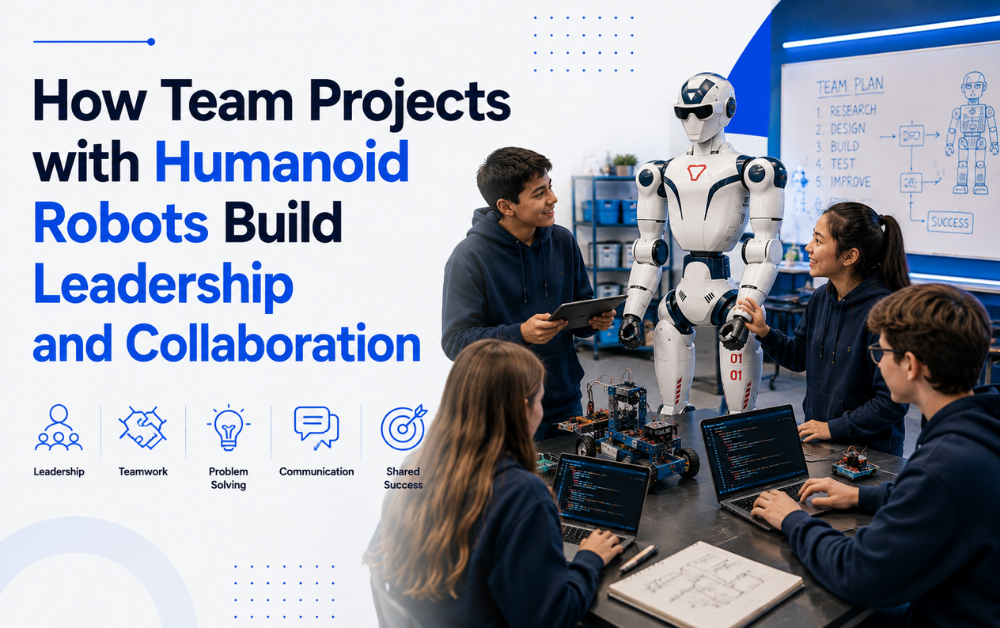
Ask any parent what they want their child to walk away with from an after-school program, and “leadership” and “teamwork” come up almost every time. The harder question is how a program actually builds those skills instead of just claiming to.
At iCode Ashburn, VA, the answer is team-based humanoid robot projects — small groups working toward one working robot, where leadership and collaboration aren’t taught in the abstract, they’re practiced under real deadlines.
What Team-Based Humanoid Robot Projects Look Like
A team project usually starts with a goal the robot has to accomplish — walk to a marked point, respond to a spoken cue, react to an object in its path — and a group of students who have to figure out, together, how to make that happen.
Real Project Examples
- Programming a coordinated routine where one student handles movement logic and another handles sensor response
- Building a simple task-completion challenge and dividing testing duties across the team
- Debugging a failed run together, with each student explaining their part of the code before the group changes it
The Leadership Skills Kids Build Through Robot Team Projects
When a humanoid robot project is broken into parts — sensing, movement, logic, testing — someone on the team has to keep track of how those parts fit together. That job doesn’t get assigned by a mentor; it gets taken on by whichever student steps up first.
That’s a deliberate part of the design, not an accident. A project with a single, obvious “right way” to divide the work doesn’t force anyone to lead. A project with real ambiguity does — and humanoid robot builds have plenty of ambiguity by nature.
Taking Ownership of a Role
Instead of one student doing everything, team projects work best when each person owns a specific piece — and is accountable for it in front of the group. That accountability, practiced repeatedly, is what leadership actually feels like at this age.
Making Decisions Under Pressure
A robot that won’t respond correctly with the clock running is a small, real pressure test. Students learn to make a call, try it, and adjust — rather than freezing or waiting for someone else to decide.
Rotating Roles Across Projects
No student stays “the leader” every time. Roles rotate across projects so the same kid who quietly handled testing last time is the one calling the shots on the next build. That rotation matters — it keeps leadership from becoming a label one student owns and everyone else defers to.
The Collaboration Skills That Come With It
Leadership without collaboration just means one student giving orders. Team robot projects are designed so that doesn’t work — the robot’s behavior depends on multiple people’s code and decisions lining up correctly.
Communication That Actually Works
Students quickly learn that “I got it working on my end” isn’t enough if a teammate doesn’t understand what changed. Clear, specific communication becomes a practical necessity, not a soft skill lecture.
Splitting Up Complex Problems
Getting a humanoid robot to complete a multi-step task is too much for one student to handle alone in the time available. Teams learn to break the problem down, split ownership, and merge their work back together.
Handling Setbacks as a Group
Robots fail mid-demo. Code that worked five minutes ago suddenly doesn’t. How a team reacts in that moment — blaming, freezing, or calmly troubleshooting together — is one of the clearest collaboration lessons a project teaches, and it’s one no worksheet can replicate.
Why the Unitree R1 EDU Platform Makes This Possible
Team projects only work if the robot is capable enough to reward good teamwork with visible results. The Unitree R1 EDU platform used at iCode gives student teams enough range to actually divide meaningful work.
Quick Spec Snapshot
| Spec | Unitree R1 EDU |
| Weight | 25 kg |
| Degrees of Freedom | Up to 40 |
| Onboard Compute | NVIDIA Jetson Orin, 100 TOPS |
| Sensing | 3D LiDAR + depth cameras |
| Programming | Python / C++ via ROS 2 |
How This Differs From a Typical School Group Project
Most students have already sat through a school group project where one kid does the work and everyone else’s name goes on it anyway. That pattern doesn’t hold up in a humanoid robot build, because the parts are genuinely interdependent — a teammate’s unfinished piece is visible immediately, since the robot simply won’t do what it’s supposed to.
That built-in accountability is what separates a team robotics project from a generic group assignment. Students can’t quietly opt out and let someone else carry it.
The Mentor’s Role: Coaching, Not Controlling
Mentors at iCode Ashburn, VA act as teachers and coaches throughout every team project — asking guiding questions, checking understanding, and stepping in when a team is genuinely stuck. The leadership and collaboration decisions stay with the students.
What Coaching Looks Like in Practice
Rather than handing a struggling team the answer, a mentor is more likely to ask, “What have you already tried?” or “Who on your team understands this part best?” Those questions push students back toward each other instead of toward the adult in the room — which is exactly the point.
Why This Matters Beyond the Classroom
The World Economic Forum’s Future of Jobs Report 2025 estimates that 39% of core workplace skills will be disrupted by 2030 — and leadership, communication, and teamwork are consistently the skills employers say hold up regardless of what technology changes around them.
Team humanoid robot projects give students an early, repeated chance to practice exactly those skills, in a setting where the stakes are a working robot rather than a job performance review.
It’s a low-risk way to fail, adjust, and try again — which is precisely the kind of practice that’s hard to get from a lecture, a textbook, or a solo assignment, and precisely the kind employers say is getting harder to find.
Frequently Asked Questions
What robot platform is used for these team projects?
iCode uses the Unitree R1 EDU platform, which gives students up to 40 degrees of freedom to program and enough onboard compute to run real perception and control tasks as a team.
How does a team project actually build leadership, not just coding skill?
Leadership shows up in the decisions a project forces — who owns which part, how the team handles a failed test run, how progress gets communicated. The robot creates the situations; students supply the leadership.
Are mentors involved during the team’s work, or hands-off?
Mentors act as coaches. They ask questions that push a team’s thinking, step in when a group is genuinely stuck, and otherwise let students make the calls — including the ones that don’t work the first time.
What age range is this appropriate for?
Team-based humanoid robot projects are built into iCode’s program for school-age students, with project complexity and team responsibility scaled to the group’s age and experience level.
Leadership and collaboration aren’t skills a student picks up from a worksheet — they’re built by being handed real responsibility inside a team, again and again, until it becomes second nature.
That’s the model behind every team project at iCode Ashburn, VA, where humanoid robots give students a reason to lead, listen, and build something together.
To see how these team projects fit into a full learning path, explore the College Accelerator Program.