
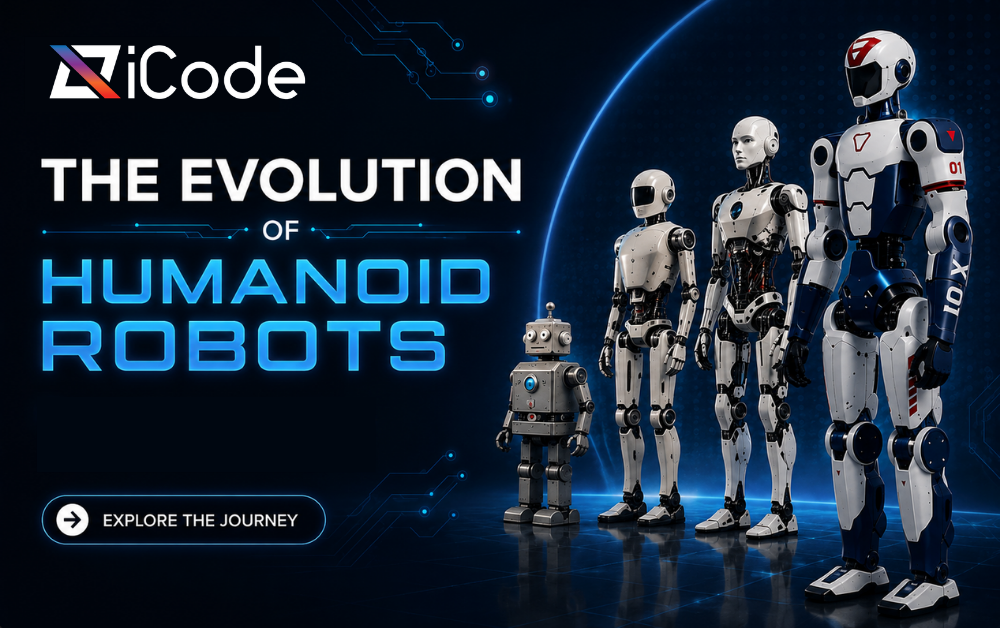
The Evolution of Humanoid Robots: From Science Fiction to STEM Education
Living in Data Center Alley
Ashburn sits at the center of what the industry calls Data Center Alley, the corridor that quietly runs a huge share of the internet’s infrastructure. Kids growing up here are surrounded by the physical backbone of modern computing, even if it’s mostly hidden behind unmarked buildings. A hands-on robotics program gives them a chance to actually touch and program the kind of technology their region is built around.
The Robot, In Detail
At iCode Ashburn, students work with the Unitree R1 EDU, a 25-kilogram humanoid robot with up to 40 degrees of freedom, an onboard NVIDIA Jetson Orin AI computer running at 100 trillion operations per second, and 3D LiDAR paired with depth cameras for real-time sensing. Students write every line of the code that controls it, in Python and C++ through ROS 2.
Tracking a Moving Target
One project has students programming the robot’s cameras to detect and follow a moving object, keeping it centered as it moves. The first attempt often lags behind or loses track entirely when the object moves too fast. A mentor doesn’t solve the timing problem directly — they help the student isolate where the delay is coming from in their own code, so the understanding sticks.
This project has a natural difficulty curve built in — a slow-moving object is manageable almost immediately, but speeding it up exposes weaknesses in the code that weren’t obvious before. Students end up testing their solution at several different speeds, which teaches them to build code that holds up under a range of conditions rather than just the one they first tested against.
Instruction Comes From a Person
Every session is led by a mentor, not the robot itself. Instructors teach the code, the mechanical gears and linkages that turn that code into motion, and the electronics connecting sensors to the onboard computer.
Youth Innovation Program, Explained
iCode runs this as the Youth Innovation Program, also known as the College Accelerator Program for what it delivers. It’s an 8-week, mentor-led cohort of 12 students split into three teams of four to five. A student can pursue robotics, or choose web and mobile app development, data analysis, AI and automation, or digital media instead — robotics is simply the path with the most exclusive access to hardware.
The Cohort Ends With a Pitch
Every group finishes with a live presentation to iCode Corporate leadership, walking through their finished project and the problems they solved to get there.
Infrastructure You Can Actually Touch
Most of what Ashburn is known for runs behind locked doors in unmarked buildings — impressive, but out of reach for a curious teenager. This program flips that. A student here gets to physically work with the sensors, the onboard computing, and the code that make automated systems function, instead of just living near a place where that happens out of sight. That hands-on access is the actual value, more than any resume line it eventually becomes.
No coding background is required going in. Most students start with basic coursework at most, and the program is built around that starting point rather than around students who already know Python or ROS 2. What matters more than prior experience is a willingness to test something, watch it fail, and try again without being told exactly what to do next.
The eight-week structure reflects that: early sessions build the fundamentals everyone needs, the middle stretch is where students build and repeatedly test their actual project, and the final weeks shift toward polishing the work and preparing for the live pitch to iCode Corporate leadership.
Twelve Seats, Limited Enrollment
Each cohort holds only 12 students so mentors can work closely with every one of them. If your student wants hands-on time with the kind of technology this region runs on, apply to the Youth Innovation Program (College Accelerator Program) at iCode Ashburn.