


AI Studio at iCode
Your child picks the project. We keep them honest.
An instructor sits with them, keeps them honest, and pushes when they coast.
- Boston Parents Family Favorite seven years running
- Macaroni Kids Favorite 2025
- FIRST LEGO League & VEX Judges Award
- State finalists, FLL & VEX
- STEM.org accredited
- CSTA & NGSS aligned
AI Studio at iCode
Price — $225 a month, one hour a week
Ages — 11 and up
Shape — your child’s own project, with an instructor alongside
Start — Start any week. Fall schedule opens Sep 14
Stop any time with 30 days’ notice. No term to see out, no penalty, no phone call you have to win. Email brookline-ma@icodeschool.com, or the Managing Director, Soundarya Ganesh, at soundarya.ganesh@icodeschool.com. Nothing renews on its own in September — every family chooses again each year.
Who this is for — and who it is not
This is for the child who already knows what they want to build and does not want to be walked through it.
- A good fit: your child has an idea, has started it on their own, and keeps getting stuck in the same place.
- A good fit: they have outgrown a club topic and want to go sideways rather than up a level.
- Not a fit: your child does not yet know what they want to make. A club gives them the brief, and that is the better starting point.
- Not a fit: you want a written record and a ten-month arc. That is the Belt Program.
How a plan gets built
The instructor tunes the plan to two things: what your child wants to learn, and what you want them to get out of it. Those are not always the same, and the conversation about the gap is part of the value.
Check the machine
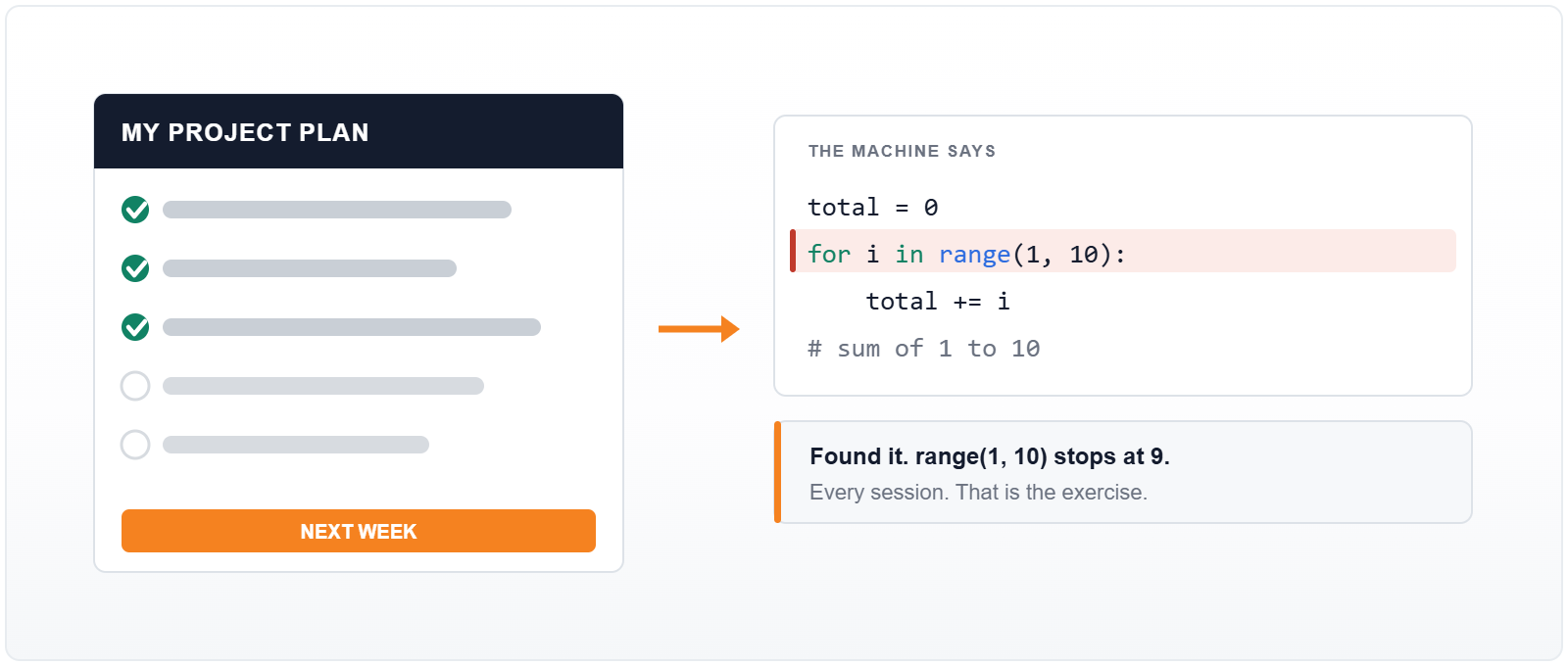
We hand them AI output with a mistake hidden inside, and they have to find it. Every session. It is the skill that outlasts whichever tool is fashionable this year.
The question every parent asks now: “Won’t AI just do this for them?” It will write the code. It will not decide what to build, and it will not tell your child when the answer is wrong. So we make finding the error the exercise.
A week in the studio
- Your child says what they got done since last week, and what broke.
- They work on their own thing, with the instructor beside them rather than in front of them.
- They get one piece of AI output to check, and they have to say what is wrong with it.
- They finish by naming what they are doing next. That is what the following week opens with.
The five habits we are actually teaching
AI can write the code. It cannot decide what to build, or tell you when the answer is wrong. That is the part we teach.
- Break it down. Split one big job into five small ones before touching the keyboard.
- Spot the pattern. Find the bit that repeats, turn it into a loop.
- Ignore the noise. Given a messy brief, decide what to keep and what to drop.
- Write the steps. Write instructions so exact that a partner can follow them literally.
- Check the machine. We hand them AI output with a mistake hidden in it. They have to find it.
How we handle AI. Your child can use AI after they have tried it themselves and can tell us what they tried. Anything AI helped with, they have to explain. Copy and paste with no explanation is not finished work.
Who teaches your child
Our instructors are college graduates with computer science backgrounds. They studied this. So when your child asks the question that is not in the lesson plan, they get a real answer.
What school does not have time for
School teaches the concepts. We teach your child how to use them.
A classroom has thirty children and a syllabus to finish. We have eight and an afternoon. So your child builds the robot, breaks the code, fixes it, and explains what they did.
Thinking about a Belt instead?
AI Studio is one hour a week and it follows your child. The Belt Program is a ten-month ladder with a written record. Plenty of families start here and step up.
Questions
Does my child need to already know how to code?
They need to have started something on their own. It does not have to be good, and it does not have to be finished.
Is this one to one?
Your child works on their own project with an instructor alongside them. It is not a class working through the same material.
What if they change their mind about the project?
They change the plan. That is allowed, and working out why the first idea stalled is usually the most useful hour of the term.
Can they do this and a club?
Yes, and plenty do. The club gives them a brief; the studio gives them their own thing.
How do we stop?
Email the campus with 30 days’ notice. There is no term to see out.
Where you’ll be
iCode of Brookline · 698 Washington Street, Brookline, MA 02482
857-547-8001
Five minutes from Brookline Middle School and a short drive from Schofield, Bates, Hardy, Hunnewell and Upham. Street parking on Central Street, plus the Municipal Way lot behind the building for pickup.
Ready to start?
Book a free evaluation. We will look at what your child has already made and tell you honestly whether the studio or a club is the better next step.
Clubs ·
The Belt Program ·
Competition Teams ·
Vacation Camps