

What You Get Every Month
You will know exactly what your child learned
Most parents six weeks into a coding class cannot say what their child has actually learned. This is how we fix that.
- Boston Parents Family Favorite seven years running
- Macaroni Kids Favorite 2025
- FIRST LEGO League & VEX Judges Award
- State finalists, FLL & VEX
- STEM.org accredited
- CSTA & NGSS aligned
Not a one-off coding club. A ten-month program with a cohort, a competition team, and a monthly report that shows you exactly what your child built and why it mattered.
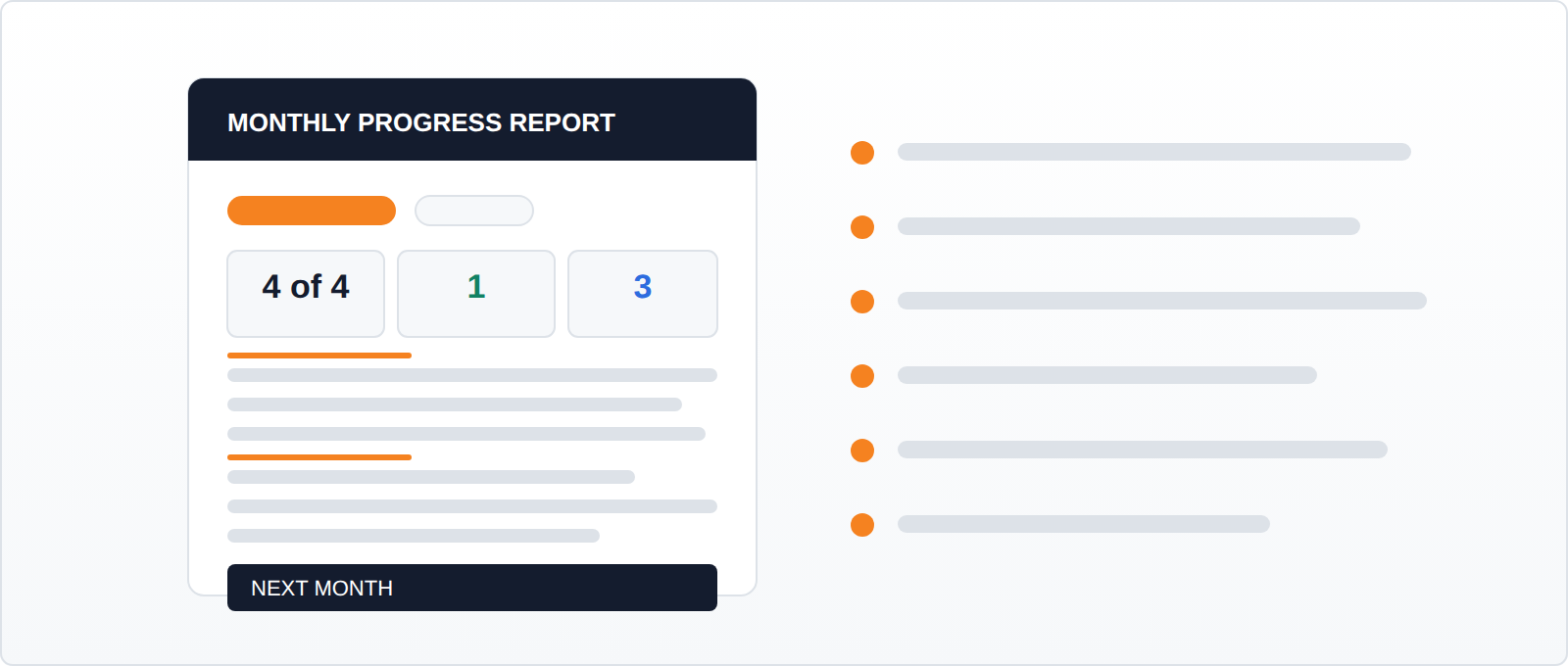
Every report contains
- The topics covered that month
- The concept behind each one, explained in plain language — not just the name of the thing
- What your child actually built
- Where they found it easy, and where they had to push
- An instructor’s specific observation about your child
- What is coming next month
And at the end of each belt
A longer completion report: the whole ten months as a narrative, a skills portfolio, the capstone project, and what the natural next step is. It carries forward into the next belt, so the record is cumulative rather than starting again each year.
Why this exists at all
Because “she had fun” is not an answer to “what did she learn?”
Ask any program you are considering how often you hear how your child is actually doing, and in what form. It is a fair question and the answer tells you most of what you need to know. Ours is monthly, written, specific to your child, and cumulative across the years they are with us.
What your child leaves with
A portfolio
Working apps, games, robots and websites they built themselves — not a certificate of attendance. Everything is saved to their own profile.
A team
The route into our VEX and FIRST LEGO League competition teams, with a real season, a capped roster and tournament results.
A transcript
A written report every month explaining what they covered, the concept behind it, and what comes next. A fuller one at the end of each belt.
Written proof of progress is one of 12 things to ask any program. See the other 11 →
Questions people ask us
Is this not just an expensive coding class?
The difference is the progression and the record. A one-off club teaches a topic. This is a ten-month sequence with a capstone, a cohort, and a written account of what was learned.
What if she loses interest after a month?
Then tell us. You can cancel at any point with 30 days’ notice, so you are never holding a year you do not want. We would rather find out quickly than have a child sitting through a year that is not working — which is part of why the report is monthly rather than at the end.
The school already has a coding club. Why pay for this?
School clubs are usually large, unstructured and staffed by whoever volunteered. This runs at six students to an instructor, with a curriculum and a documented outcome.
Do we have to commit to the whole year?
It is designed as a ten-month arc and that is how the curriculum builds, so it is the commitment we ask for. But you are not held to it — you can cancel at any point with 30 days’ notice. If ten months is too much right now, Studio is a one-hour weekly option that students move across from when they are ready.
Do clubs get a report too?
No, and that is deliberate. Clubs get a short end-of-term note. The monthly written report is what the Belt Program is for, and it stays there.
Where you’ll be
iCode of Wellesley · 73 Central Street, Wellesley, MA 02482
781-291-3131
Five minutes from Wellesley Middle School and a short drive from Schofield, Bates, Hardy, Hunnewell and Upham. Street parking on Central Street, plus the Municipal Way lot behind the building for pickup.
See one for yourself
Book a free evaluation and we will place your child honestly — and show you the report a family received last month while you are here.